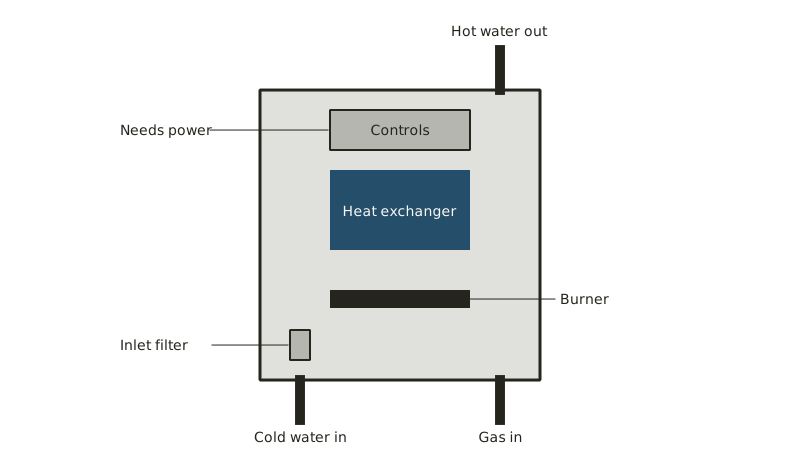
A storage heater fails slowly, with lukewarm showers and a puddle. A tankless unit tends to fail all at once: water runs, but it is cold, or it runs hot for a minute and then quits. Four culprits cover most cases, and the first two take only minutes to rule out. Problems common to all heater types are gathered on the water heater repair hub.
Is the faucet flow too low for the heater to switch on?
Possibly, and it is the most overlooked cause. A tankless heater fires only when water moves through it fast enough. The Department of Energy's Building America guideline puts the minimum between 0.4 and 0.9 gallons per minute depending on the unit. A trickle from a faucet opened a crack may not trip the sensor, so the water stays cold.
Try opening the hot tap fully, or run a second fixture at the same time, as the guideline suggests. If hot water appears, flow was the issue. Low-flow aerators and showerheads can contribute, since they cut the volume that reaches the heater, and an aerator choked with grit makes it worse. Unscrew the aerator and rinse it.
A related quirk is the cold-water sandwich. Turn the shower off and on again within moments, and a slug of cold water can reach you before the burner relights. The guideline says it is rare, since most units are ready to fire within a minute or two of the last use, but safety rules require a delay in the ignition sequence, so it cannot be eliminated.
If you have a single-lever faucet or a bathroom sink with a low-flow aerator, those are the spots where this shows up most, and a plumber can suggest swapping the aerator or adding a recirculation loop.
Has the unit lost power, gas or water?
Check the plain things first. A tankless heater needs electricity for its controls, even on a gas model, and the Building America guideline notes that those controls do not work in a power outage. A tripped breaker, an unplugged cord, or an outage will leave a gas tankless unit cold with the display dark.
Then look at the supply side:
- Gas valve. Is the shutoff to the heater open, with the handle in line with the pipe?
- Earthquake shutoff. If the house has an automatic gas shutoff valve and it tripped after a tremor, it may have cut gas to every appliance, so the heater is not the only one that is dead. How they behave, and the care needed in resetting one, is covered under earthquake gas shutoff valves.
- Water isolation valves. The inlet and outlet isolation valves should both be fully open.
- Display. Many units show a code. Note it, then find its meaning in your model's own manual, since brands assign different meanings to the same number.
If you catch a gas odor, the troubleshooting is over: get everyone out, leave switches alone and phone from outdoors. Customers in Long Beach and Signal Hill are on the city's own Long Beach Energy Resources, (562) 570-2140. Neighboring cities buy from SoCalGas, 1-800-427-2200. Anyone in danger should call 911.
Could hard water scale be choking the heat exchanger?
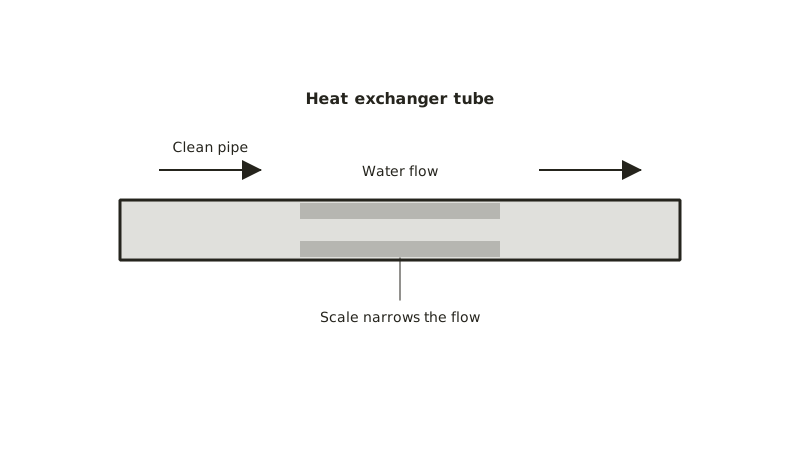
It is a leading cause of declining performance, and Long Beach has the water for it. Scale from calcium and minerals builds up in the heat exchanger of a tankless unit, restricting flow and shortening its life, as the federal Building America guideline explains. Some makers void the warranty without water treatment once hardness passes roughly 12 grains per gallon, so read your manual.
Long Beach Utilities' 2025 water quality report lists hardness of an average near 12.8 grains per gallon across the imported-water zone, peaking at 17.5, versus roughly 4.4 in the blended zone. Which zone your street is in decides which number applies, so check the utility's map or call (562) 570-2300. San Pedro and Wilmington are supplied by LADWP, which publishes its own report to consult.
The remedy is flushing the unit with a descaling solution, following your manufacturer's instructions. Per the guideline, makers suggest anywhere between two flushes a year and one every third year, depending on the model, usage and water. Many owners hire this out, because it means isolating the unit and handling a pump and acid-type cleaner. If you are in a hard-water zone, ask about a softener, and read about removing hard water scale and whole-house softener installation.
What else stops a tankless heater from producing heat?
Several smaller faults can do it. A clogged inlet water filter screen cuts the flow. On a high-efficiency model, a blocked exhaust vent or condensate drain can shut the unit down. A dirty flame sensor or igniter prevents the burner from staying lit. An undersized gas line can starve a unit when other gas appliances run.
Error codes vary, so I will not list numbers that apply to every brand. Find the code in your model's manual or the maker's support site. It typically points to ignition, flame, venting, condensate or overheating, which in turn shows whether a reset is enough or a technician is needed.
What a homeowner can reasonably do is limited. Reset the unit by turning off power for a minute, check that the vent terminal is not blocked by a nest or debris, clean the inlet filter if the manual shows how, and rinse the aerators. Anything that opens the gas train, the burner or the controls belongs to a plumber or technician.
At what point should I phone someone, and what does swapping the unit involve?
Call when the checks above do not restore hot water, when the same code returns after a reset, when you see soot, scorching or water leaking from the unit, or when you smell gas. A plumber can test flow, gas pressure, venting and the heat exchanger, and tell you whether a repair or replacement makes sense. The page on tankless gas heater repair goes further into the repair side.
A repair that does not disconnect the heater is exempt from a Long Beach plumbing permit, but replacing a water heater requires one, and Long Beach wants the new heater strapped against shaking. If you are weighing a swap, compare tank versus tankless heaters and read about tankless installation. Visit pricing in writing comes through the quote form. Tank models are covered in the broader no hot water guide.
Common questions
What explains hot, cold, then hot again at the shower?
Usually it is either a flow dip or the cold-water sandwich. Frequent short on-off use leaves a slug of cold water in the pipe before the burner relights, and a flow that drops near the minimum can make the unit cycle. Run the hot water steadily, open the tap further, and note what happens when you pause.
Does it keep running when the electricity goes out?
Generally not. Even gas-fired units rely on electric controls, and the federal guideline says those controls are dead in an outage, mentioning a battery backup as one fix. Anyone worried about outages should ask the installer what backup suits the model.
What is the right flushing schedule?
Your manual rules. The guideline reports a wide spread among makers, from two flushes yearly to one per three years, shaped by model, use and water quality. In Long Beach's harder zones, lean toward the shorter interval and ask if a softener is needed to protect the warranty.
Can I fix it myself if it shows an error code?
You can look up the code, reset power, clean an aerator or the inlet screen, and check valves. Leave the gas train, burner and control board closed. If a code repeats after a reset, call a plumber, and have the model number and the code ready.
This guide is one of many on plumber in Long Beach.
References
- U.S. Department of Energy, Building America, Measure Guideline: Transitioning to a Tankless Water Heater
- U.S. Department of Energy, Building America, tankless water heaters
- Long Beach Utilities, 2025 Annual Water Quality Report
- City of Long Beach, plumbing permit and water heater requirements
- Long Beach Energy Resources (Long Beach Utilities), gas
- SoCalGas, natural gas leaks
Updated