Pipes inside walls give no warning until they fail, so a repipe is usually decided by pattern: a second pinhole leak in the same year, brown water on first use each morning, a shower that has slowly gone weak. If that sounds familiar, you are probably weighing a whole-house repipe against patching. Southern California's old houses all get here eventually. Below is the decision laid out for Long Beach, where the question comes up most in the older neighborhoods. Other trade work we arrange is listed on our front page; to see what yours would cost, fill out the quote form.
What happens, step by step, on a repipe job?
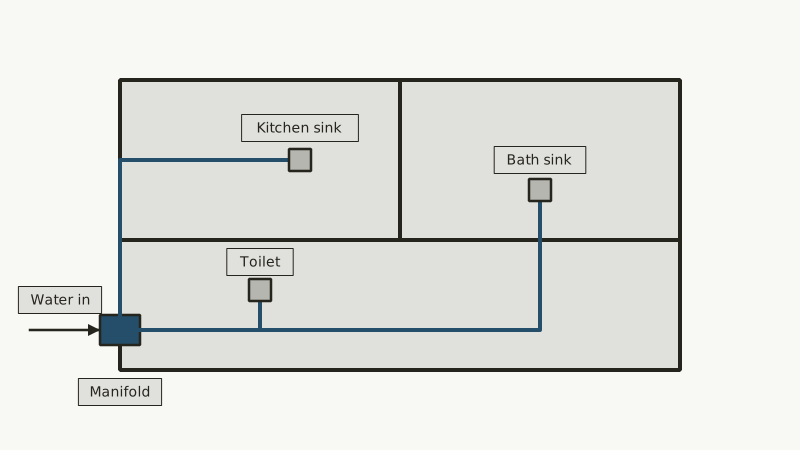
A local plumber shuts the water, opens small access holes in drywall, runs new supply lines to every fixture and reconnects each one, then pressure-tests the system with an inspector watching. The old pipe is abandoned or pulled out. Drains and vents are normally left alone, since the job concerns only the pressurized water lines.
Most homes take a few days, and sources quote two to five, longer if walls are finished and many bathrooms are involved. Plan on daytime hours with the taps dead. Expect the plumber to stage the work room by room so the kitchen or one bathroom stays usable. Plaster and paint repair is a separate step that is often not in the pipe quote at all.
Do my pipes need replacing, or only repairing?
Replace when failures keep arriving. One failure in otherwise healthy pipe calls for a patch, not new lines. Leaks in several rooms across a year or two, rust-colored hot water, pitted fittings you can see in the garage or under a sink, and pressure that keeps sliding all point at the pipe itself instead of a single joint.
Material gives the verdict faster than symptoms. Gray plastic called polybutylene was widely installed from about 1978 to 1995, and galvanized steel fills many pre-war houses. Our pages on polybutylene replacement and galvanized pipe replacement show how to recognize each. If the leak sits beneath your foundation, weighing a slab repair against a repipe helps.
Which material goes in, PEX or copper?
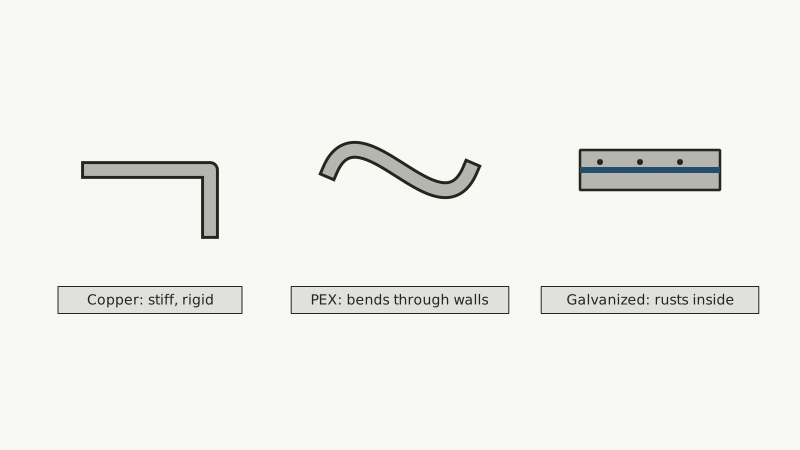
Both are accepted in California. California's Building Standards Commission added PEX to the state plumbing code in January 2009, and the rules took effect on August 1 of that year. PEX bends, so it snakes through closed walls fast, and the saved labor is most of its price edge. Copper is stiffer, costs more, and has the longer track record.
Salt air near the harbor is a fair reason to ask the plumber how copper will hold up on your street. Do not pick on price alone. Our PEX and copper comparison lines up both, PEX types A and B explains the grades, and the PEX repipe walkthrough covers the install itself.
What will a repipe cost, and what makes it swing?
Guides we read land the bulk of whole-house repipes from $4,000 to $15,000 (a wide band), with $7,500 as the national mean. A two-bath home of 1,200 to 1,800 square feet lands near $4,000-$7,500 with PEX and $6,000-$11,000 with copper, per one guide. None of this replaces a written quote after someone sees the house.
Access sets the bill. A slab foundation, two stories or finished walls add labor, and a typical drywall patch-and-paint can run $1,000 to $3,000 extra if it is not in the quote. Add the permit. Our cost page has a fuller table, and replumbing an old house covers older stock.
What does the law require for a repipe?
A permit, yes. Long Beach requires a plumbing permit whenever piping is altered, repaired or replaced, and water piping has to be tested at street main pressure or 50 psi with the inspector present. Contractors need a state license on jobs of $1,000 or above, parts counted in, and a repipe clears that bar easily.
Before signing, verify the number with CSLB, the state board. Money up front has a ceiling: 10% of the contract, or $1,000 flat, and the smaller figure rules. Long Beach allows a resident owner to apply for a permit on personal work, so is a do-it-yourself repipe possible? Sometimes on paper. Still, it is no beginner project, and we would hand it to a contractor.
Will homeowners insurance pay for new pipes?
Generally not for the pipes. Policies lean toward covering sudden, accidental discharge, like a line that bursts and soaks a floor, and away from replacing tired pipe or chasing a slow drip. Whether the failed pipe itself is paid varies; get the insurer's answer in writing.
On the other point people ask, what not to tell the insurer: do not guess at causes, do not offer opinions about fault or age, and do not sign a statement you have not read. Give dates, photos and plumber invoices as facts. Our piece on insurance and burst pipes goes further.
What should a solid repipe quote contain?
A good quote reads like a checklist: pipe type, fixture count, permit owner, drywall responsibility, schedule, license number, and a clause for surprises behind the walls. Compare two or three bids built on the same scope, because a bid that leaves items out looks cheaper only until the extras arrive. Two or three comparable quotes beat one low number.
Older neighborhoods bring surprises: bungalows built between 1920 and 1959 in Belmont Shore and Bixby Knolls can hide mixed materials from earlier fixes, and Lakewood's postwar tract houses often sit on slabs. See the Belmont Shore page for that neighborhood's housing.
Common questions
When do supply pipes wear out?
There is no set number, because material and water quality drive it. Guides put PEX near 40 to 50 years and copper at 70 to 100, and much less for galvanized steel and polybutylene. A house that has never been repiped and is over 50 years old deserves an inspection.
Does a repipe pay off ahead of a sale?
It can be, particularly when an inspector would flag galvanized or polybutylene lines, since buyers and insurers react to them. It also makes sense when you are already opening walls for a remodel. If the pipes are sound, a repair and a clean inspection report cost far less, so get a plumber's opinion first.
What is the lowest-cost route that is still sound?
Choose PEX, keep fixture locations unchanged, and let the plumber work through attic or crawl space routes so fewer walls are opened. Patch the access holes yourself if that suits you. Skipping the permit or the license check is not a saving, because it risks a failed inspection and an unrecoverable payment.
Which points should a contractor confirm before work begins?
Request the license number, the pipe brand and type, the name of whoever files the permit, how walls get closed up, and how many days the water stays off. Also ask what a change order costs and how it is approved. Answers in writing are the point.
More in this guide
- Repiping and pipe replacement
How a whole-house repipe is done in Southern California: the steps, what changes on a slab foundation, PEX or copper, Long Beach permits…
- Galvanized pipe replacement
How to tell if your house has galvanized steel pipe, when to replace it, what repiping with PEX or copper involves, whether it needs a…
- Repiping with PEX
Repiping a Long Beach house with PEX: how the job goes, what it costs in Southern California, permit and flushing rules, and whether to do…
- PEX-A or PEX-B
PEX-A and PEX-B both work for household repiping.
- Polybutylene replacement
Polybutylene pipe in a Long Beach home: how to spot it, why it fails, what replacement costs, what it means for insurance and selling, and…
- PEX vs copper
PEX or copper for a Long Beach repipe: cost per foot, lifespan, flow, freezing, fittings and what California and Long Beach rules allow.
- Repiping cost
What a whole-house repipe costs in Long Beach: a price table by house size for PEX and copper, what moves the total, and how to compare…
References
- City of Long Beach, plumbing permit requirements and pressure testing
- California Contractors State License Board, hiring a contractor
- California Contractors State License Board, home improvement contracts
- Contractor Magazine, California approves PEX for state plumbing code
- NAIC, will my homeowners policy cover water damage from a burst pipe
- Plumbing Price Guide, repiping cost 2026 (updated March 2026)
- U.S. EPA, Fix a Leak Week
- Estimator Suite, cost to repipe a house (2026)
Updated