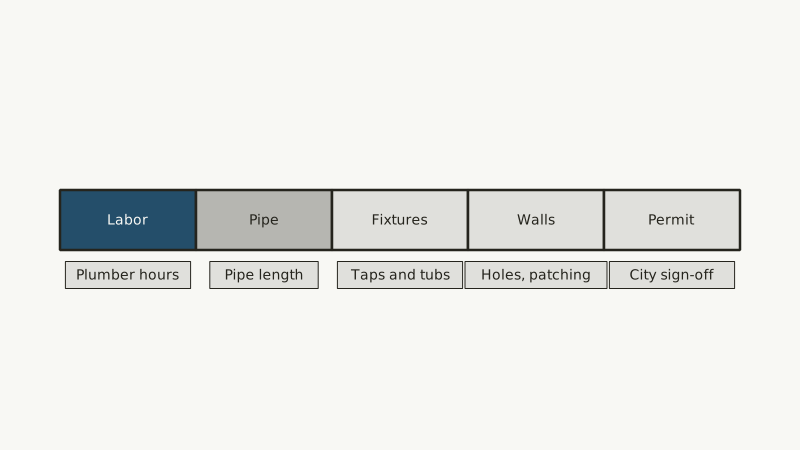
Budget $4,000 to $15,000 for most whole-house repipes, and expect the low end for a compact one-bath place in plastic pipe, the high end for a large copper job with finished walls. The gap is big since wages for hours spent in tight spaces dominate the invoice, and hours follow wall access. This page sets the figures out by house size and pipe, and the main repipe house guide explains the process behind them. What follows is drawn from published cost guides. The price that counts arrives in writing after someone has seen your house.
What does replumbing a 1,500 sq ft house usually cost?
A home of 1,200 to 1,800 square feet with two bathrooms is listed at about $4,000 to $7,500 for PEX and $6,000 to $11,000 for copper in one 2026 price guide. Plan on the middle of that band for an ordinary layout. Slab foundations and two stories push toward the top of it.
| Home size | Copper | PEX |
|---|---|---|
| 1 bath, under 1,200 sq ft | $4,500 to $8,000 | $2,500 to $5,000 |
| 2 baths, 1,200 to 1,800 sq ft | $6,000 to $11,000 | $4,000 to $7,500 |
| 3 baths, 1,800 to 2,500 sq ft | $8,000 to $15,000 | $6,000 to $10,000 |
| 4+ baths, 2,500+ sq ft | $12,000 to $20,000+ | $8,000 to $14,000 |
Other guides differ, sometimes widely, so take the table as a midpoint only. Get quotes with the same scope before comparing.
How do I do it for the least money without cutting corners?
Pick PEX, keep every sink, toilet and shower where it is now, and let the plumber run lines through attic or crawl space where possible. Fewer opened walls means fewer labor hours and less patching. Patching the drywall yourself can save $500 to $2,000 on some jobs, per one guide.
What does not count as saving: skipping the permit, taking a bid with half the scope missing, or hiring someone who cannot show a contractor license. Long Beach requires a plumbing permit for replaced piping, and a failed inspection or a botched job costs far more than the premium you avoided. A bid that excludes drywall, permit or fixture reconnection is not cheaper, only unfinished.
Which old-house plumbing is the problem material?
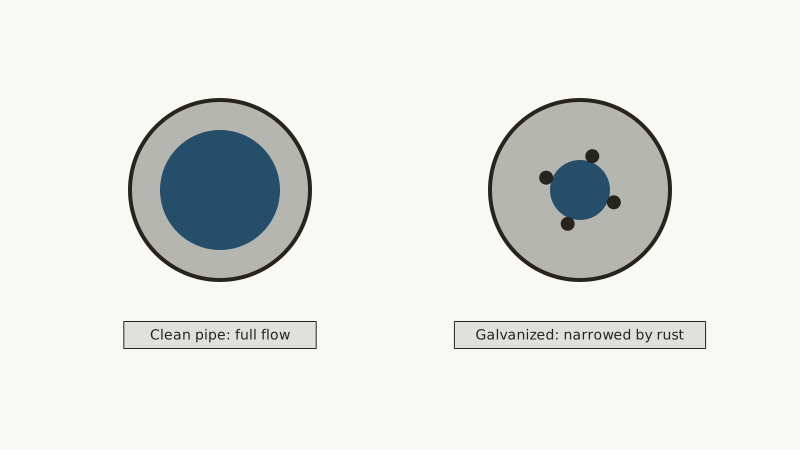
Three materials account for most replacements. Galvanized steel rusts internally, narrowing until the flow is a trickle, and many older houses still have it. Polybutylene, a gray plastic used roughly from 1978 to 1995, has a poor reputation. Lead pipe is associated with homes from before about 1930. If your Belmont Shore or Bixby Knolls bungalow was built in the 1920s or 30s and never repiped, check.
Across Southern California, houses from later decades, such as Lakewood's postwar tract homes, sit in a different position. Copper can last for decades, but pinhole leaks can begin at poor solder joints or in aggressive water. Our pages on galvanized pipe and polybutylene show how to identify each.
How often should a house be repiped?
Lifespans in guides: PEX, forty to fifty years or more; copper, seventy to a hundred. Those are ceilings, since water chemistry, pressure and installation quality shorten them. Rule of thumb: a house older than 50 years that has never been repiped deserves a plumber's opinion, and repeated leaks in separate spots matter more than the calendar.
Statewide approval of PEX arrived only in 2009, which means any California PEX system is relatively young. If your supply pipes are galvanized, expect trouble sooner. Compare the two materials directly before you decide.
How much more does copper add?
Copper commonly runs about twice what PEX does. A 2,000 sq ft home is shown in one group of guides at $4,000-$10,000 using PEX and $8,000-$18,000 using copper, averaging about $6,500 and $12,500. Pipe material alone is published at roughly $2 to $8 a foot for copper and $0.40 to $2 a foot for PEX.
Material is the smaller slice. Labor is commonly estimated at around 70 percent of a repipe, and copper joints take longer to solder than PEX fittings take to crimp. If you have copper now and only a handful of leaks, a partial replacement may be enough, which is covered below.
What about a per-square-foot price, or a calculator?
Calculators apply one rate per square foot, and the sources disagree: about $2-$7 for PEX, $4-$14 for copper, and a middle reading near $4.50-$6 for PEX. A slab or several floors can add a quarter to a half. Because the tool never sees your walls, use it as a smell test for a bid, and do not let it stand in for one.
Permit fees and wall repair are left out of calculators. A better habit is to ask three contractors for itemized quotes, and to take the bathroom count and fixture count off your own house first so every bid starts from the same facts.
What if I only need one bathroom, a few fixtures or a condo unit repiped?
One guide lists a partial repipe at $1,000 to $4,000, and an additional fixture connection at $200 to $500 apiece. One-bathroom jobs often make sense when only that part of the house has failed pipe. Do not stretch the scope so far that a second leak appears next year in the section you skipped.
For a condo or townhouse, the first question is ownership: the building's association might own the main risers and you own the branch lines, so check the governing documents before booking anything. Condo repipes can also involve neighbors' units and shutoff schedules. Small houses with easy attic access cost least, and our old-house replumbing guide covers the surprises.
What is missing from the quote that I will still pay for?
Drywall. Repair of the access holes, with texture and paint, is often excluded and is estimated at about $1,000 to $3,000. The permit comes next; a guide lists $100 to $400 for one, though check the city's fee schedule for the exact amount. Insulation, fixture replacement and a new pressure regulator are other possible additions.
Ask whether the price includes reconnecting fixtures, hauling off old pipe and the inspection visit. On payment, the state caps what a contractor may collect before starting at $1,000 or 10% of the contract, using the lower, so a request for half in advance breaks the pattern. For real numbers, give us the particulars on the quote form.
Common questions
Which pipe is the better choice, PEX or copper?
PEX usually wins on price and install speed. Copper wins on track record and stiffness. Both are allowed in California. Pick by budget, by how open your walls are and by how the plumber feels about each. Whichever you choose, the permit and test are the same, so quality of installation matters more than the label.
What budget fits a 1,500 sq ft place needing new lines?
With two baths, set aside about $4,000-$7,500 for PEX or $6,000-$11,000 for copper, with wall repair and the permit coming on top. Add a margin for hidden problems in an older house. If the plumber's number is far outside that band, ask them to explain the difference line by line.
Does the price change in Long Beach compared with elsewhere?
The guides I drew on are national or statewide, which leaves local labor rates and access out. Long Beach's mix of older bungalows near the water and slab tract homes inland means jobs vary by neighborhood. Use the table to orient yourself and let quotes from here decide, ideally from at least two contractors visiting the house.
For what the work involves beyond the price, see plumber in Long Beach.
References
- Plumbing Price Guide, repiping cost 2026 (updated March 2026)
- City of Long Beach, plumbing permit requirements and pressure testing
- California Contractors State License Board, home improvement contracts
- Contractor Magazine, California approves PEX for state plumbing code
- Published whole-house repipe cost guides and calculators, checked November 2026
Updated