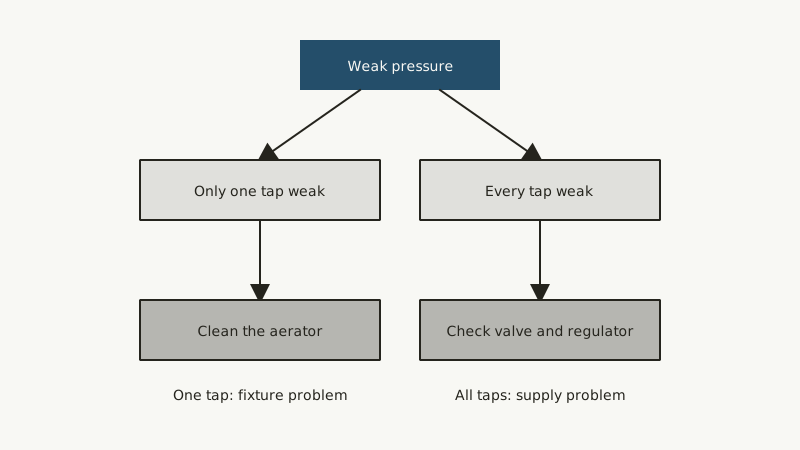
Start with one number. A pressure gauge threads onto the outdoor spigot; close the taps indoors, then look at the needle. Somewhere in the 40s to 60s psi tells you the street supply and the regulator are fine, so the culprit is a single fixture or branch. Under 30 psi, suspect the regulator, a main that is only part open, or a leak. The rest of this page builds on that reading, and our Harbor Lights front page lists other trade jobs we arrange.
Is the pressure low everywhere, or only at one tap or the shower?
A single weak tap implicates that tap: a plugged aerator, a showerhead crusted with minerals, or a pinched supply hose. Weakness everywhere, hot and cold alike, implicates the main line, the regulator or the city. If only the hot taps sulk, look to the heater and its neighboring valves. Working out which pattern you have is most of the diagnosis, and ten minutes will do it.
At a faucet, twist off the aerator, drop it in a cup of white vinegar for an hour, and rinse the grit from the screen. The showerhead can sit in the same bath. Hardness varies by zone across the city, with the utility's 2025 report listing one zone around 4 grains per gallon and another around 13. In the harder zone, tiny nozzle holes clog with scale fast. Our notes on shower pressure and a kitchen faucet that trickles go further, and hot-side pressure problems get their own page.
If the whole house is weak, look at the main shutoff before anything else. Someone may have left it a few turns short of open after earlier work, and that chokes everything downstream. Open it all the way and take a second reading.
What if the pressure dropped overnight, or when the weather turned cold?
An abrupt loss nearly always has a physical cause. Candidates are a main valve bumped partly closed, a regulator that gave out, a new leak, or construction on the street main. Weather matters less on this coast than in colder states, since freezing is uncommon, so a chilly morning is not enough to blame ice.
Ask next door. When neighbors report weak taps too, the cause sits on the supply side, and the number for Long Beach Utilities water emergencies is (562) 570-2390. San Pedro and Wilmington are supplied by LADWP, so that agency is the one to reach there. If your house is the only one, shut every tap and study the meter. A creeping dial means water is getting away from the pipes, so the pressure complaint is really a leak complaint. The order of checks is spelled out in our piece on a sudden pressure loss.
Who do I phone about weak pressure, the city or a plumber?
Think of the meter as a border. The utility looks after the system up to and including it, and whatever lies beyond it belongs to you. When several households are affected, the utility is the contact. When only yours is, hire a plumber, since the regulator, the house lines and the fixture valves are all private. One visit generally settles which side holds the fault.
Waiting on the utility for a fault it does not own wastes a day, because it will send you back to check your own pipes. Write down the gauge reading, the weak taps, whether the drop was sudden, and the last time anything was replaced. Include the notes when you fill in the quote page, so whoever comes brings suitable parts.
Homes on a private well follow different rules, because the pump and the pressure tank set the pressure; the well pressure guide covers that case.
What is a regulator actually for, and when does it wear out?
Look for a bronze-colored bell on the pipe, sitting on the supply line soon after it enters the property; its task is to take street pressure down to what fixtures and appliances can tolerate. Lifespan estimates in published guides range from roughly 5 to 20 years, and most land between 10 and 15. A failing one can let pressure wander either direction, high or low.
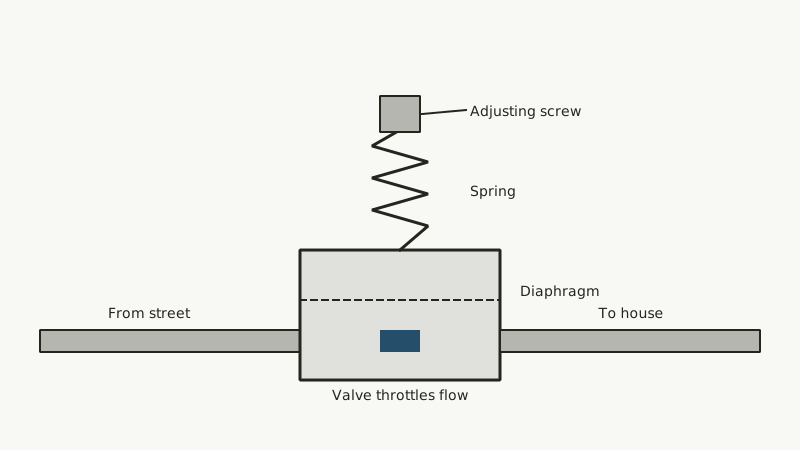
The state plumbing code draws its line at 80 psi: past it, a regulator is mandatory to pull the figure under. Plumbers usually set it lower. A steady, healthy reading outside paired with feeble flow indoors clears the regulator. A needle that bounces, or one parked near the bottom of the dial, tends to implicate it. See where the regulator hides if you have never seen yours, and how it is adjusted before you touch a screw.
What does restoring normal pressure cost?
The cause sets the bill. A cleaned aerator is free. Replacing a dead regulator lands between $200 and $700 across the country, and Angi's 2026 data averages about $400. Rusted galvanized lines or a hidden leak push it higher. People hunting for a low-cost plumber should know that a simple valve or aerator fix is cheap, yet an honest quote still needs a gauge reading.
Hardware is the smaller line item; labor and reach make up the bulk. One mounted on a garage wall is a quick visit, while one behind stucco or under the house eats more hours. The regulator installation cost page itemizes it. If the real villain is galvanized steel, plausible in Belmont Shore and Bixby Knolls bungalows built before the late fifties, the fix becomes new piping and the figure climbs.
Do plumbers fix a broken or corroded supply pipe too?
They do. The same visit can cover a split or rusted supply line, a weeping fitting or a worn shutoff valve. Long Beach exempts a leak stop that needs no new materials from its permit requirement, but replaced piping or fixtures usually do need one, so ask the plumber where your job falls.
Older neighborhoods matter here. Postwar tract homes in Lakewood sit on slabs and often have lines that enter at the front, while San Pedro hillside houses can have long runs and elevation changes that affect pressure at upstairs fixtures. Neither is a defect, but both shape what a plumber recommends. A hidden leak is the one case where pressure loss and a rising bill arrive together.
How can I tell a good plumber from a dodgy one?
Before agreeing to anything, enter the contractor's name in the state board's license lookup. Jobs from $1,000 up in labor and materials fall under California's licensing rule, so a person pitching a big repair with no license number is waving a flag. Ask for the scope, price and permit fee on paper.
Deposits are limited too, to no more than ten percent of a home improvement contract or $1,000, the lower of the two. If someone wants half the price before starting, push back. Also be wary of a phone diagnosis with no gauge reading, a refusal to pull a required permit, and any push to sign right now.
Is weak water flow a safety issue, and is it related to blood pressure?
Weak flow by itself is an annoyance, not a hazard: slow tub fills, thin showers, a dishwasher that sulks. The cause is what deserves attention, for instance a leak inside a wall. Pipe pressure, measured in psi, has nothing to do with a person's blood pressure, and a health question belongs with a doctor.
One more point: the pressure rating of the plumbing itself is a one-way street. Raising pressure to fix a weak shower can stress an aging water heater, so a plumber who finds a healthy gauge reading may suggest a better showerhead before touching the regulator. The EPA's WaterSense program rates showerheads at 2.0 gallons a minute or less and requires a minimum flow across a range of household pressures. Our guide to the best showerheads for low pressure has the buying notes.
What does weak pressure do to sprinklers and the bathroom?
Irrigation shows it first. Heads fail to rise all the way, patterns shrink to a dribble, and the zone farthest from the valve suffers most. A clogged filter or a half-open valve is the usual reason, though dividing one zone into two can help. Indoors, watch how long the toilet takes to refill and whether the shower keeps its spray.
Weak lawn and weak bath together suggest the supply side. Bathroom alone suggests scale in the showerhead or the small stop valves. A self-guided checklist lives in the article on raising pressure at home, causes are laid out in why pressure drops, and if the verdict is a worn valve, swapping the regulator shows what that job involves.
Common questions
How soon is the cause identified?
The gauge reading is about a minute of work, and one visit usually narrows the fault to a zone of the house. A regulator swap tends to run a few hours. Rusted pipe, an awkward regulator location or a leak behind finished walls stretches that.
Should somebody be home during the visit?
Best if so. The main shutoff needs to be pointed out, the weak taps described, and the household should expect the supply to be off for a stretch. Agree on the price before tools come out. Our request window is weekdays, 9 to 5.
Can I raise the pressure myself with the regulator screw?
You can, with care. Too much pressure strains pipes and the water heater, and the legal ceiling is 80 psi static. Leave the gauge on the spigot, nudge the screw a little at a time, and quit at a comfortable reading. A needle that will not respond means the valve itself has probably died.
Does swapping a regulator mean pulling a permit?
The city calls for a plumbing permit when fixtures or equipment are installed or replaced, and exempts only repairs that add no new materials. Since a replacement regulator is new material, expect a permit. The plumber should confirm and file it; questions can go to Building and Safety at City Hall.
More in this guide
- Water pressure and valves
Adjusting a home pressure regulator starts with a gauge, not a wrench.
- Water pressure and valves
Choosing a showerhead for low water pressure: what to look for, California's 1.8 gpm flow limit, why a new head cannot fix a plumbing…
- DIY pressure fixes
A do-it-yourself order of attack for low water pressure in a Long Beach house: free checks first, what the city says is normal, booster…
- Sudden low pressure
When pressure drops all at once, check the street, main valve, regulator and leaks in that order.
- Garden hose regulator
Do you need a water pressure regulator on a garden hose?
- Regulator replacement
How a water pressure regulator is replaced: signs it has failed, what a new one must match, the steps, the expansion tank rule, Long Beach…
- Well pressure
Low pressure on a private well: tank, switch, pump or filter?
- Pressure regulator location
Where to find the water pressure regulator in a Long Beach house: garage, crawlspace, water heater area or a front-yard box.
- Cost
What a water pressure regulator costs to install or replace in Long Beach: price ranges, what moves the bill, code limits and what to ask…
- Why is my water pressure low
Low water pressure at home: the usual causes ranked from cheap to costly, a 15-minute test to find yours, and whether the city or a…
References
- Angi, cost to replace a water pressure regulator (2026 data)
- California Plumbing Code 608.2, excessive water pressure
- Long Beach Utilities, water services and emergency contact
- Long Beach Utilities, 2025 water quality report
- U.S. EPA WaterSense, showerheads
- City of Long Beach, plumbing permit requirements
- California Contractors State License Board, hiring a contractor
- Published cost guides for a regulator swap, checked November 2026
Updated