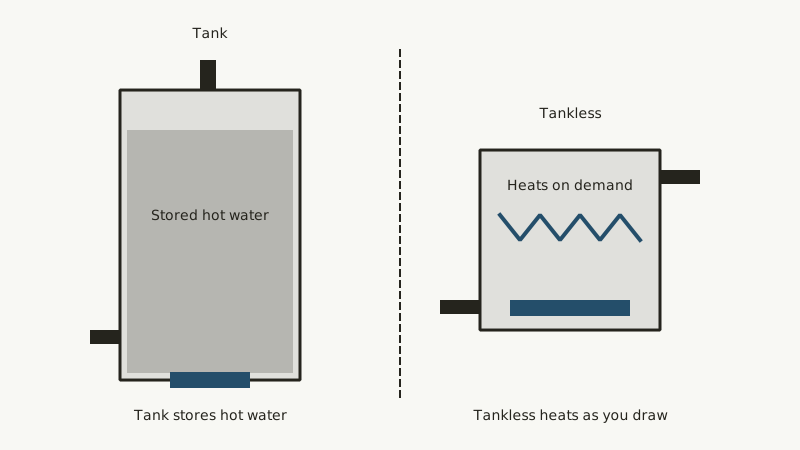
Most households that stay in a home for ten years or more and burn through plenty of hot water come out ahead with a tankless water heater, and most households that want the cheapest swap today stay with a tank. The right pick turns on your gas line, your usage and your budget. If a unit has already died, start with the water heater repair page, then come back here to compare the options.
Which one suits your household, a tank or a tankless unit?
A tank suits small budgets, houses where the existing tank can simply be exchanged for a new one in the same spot, and households with unpredictable demand. A tankless unit suits people who use moderate or steady hot water, want a smaller footprint and expect to stay put. Gas homes need the most planning, because the line has to carry more.
Here is a quick sorting guide:
- One or two people, modest showers: tankless saves the most energy proportionally, and a small electric model can be enough.
- Family of four showering in a row: a gas tankless works if sized for peak flow, or a 50-gallon tank rides through the morning rush with less drama.
- Rental or house you may sell soon: a tank rarely pays back less than a tankless unit does within that window, so the cheaper swap usually wins.
- Cramped closet in a Belmont Shore or Bixby Knolls bungalow: a wall-hung tankless frees floor space.
- Granny unit or garage apartment: tankless fits where a tank would not.
How do they compare on efficiency and running cost?
Federal energy figures (DOE) say demand-type heaters can run about 24 to 34 percent more efficiently than storage tanks in homes using 41 gallons or less per day, and 8 to 14 percent more in homes using far more. Savings shrink as usage rises, so a big family sees less relative gain than a couple.
Where that gap comes from: a storage tank keeps dozens of gallons hot all day and loses a little heat through its walls, while a tankless unit ignites just when somebody opens a tap. That is the whole story for gas. For electric models the question is different. A storage tank is already close to a pure resistance heater, so an electric tankless unit's edge is smaller, and its bigger electrical draw may force a panel upgrade.
DOE also puts storage heaters at about ten to fifteen years of use, while tankless units pass twenty. A longer lifespan helps the math only if you keep the home that long.
A rough way to size demand, in place of an online calculator: add up the flow of every fixture that might run at once (a shower is often around 2 gallons per minute, a kitchen faucet about 1.5), then multiply gallons per minute by the temperature rise in degrees and by 500 to get the BTU per hour the unit must deliver. A plumber runs this sum on site with your actual fixtures.
What does each type cost once it is installed?
Published guides put a standard tank swap at roughly $800 to $2,500 installed, and a tankless unit at about $1,400 to $5,600, with gas models at the high end. Tank-to-tankless conversions cost more than like-for-like swaps because of venting, gas pipe and wall work. Use these figures for orientation only, and lean on the written quote for the real number.
| Item | Typical installed range (guide) |
|---|---|
| Electric tank, 40 or 50 gallons | $700 to $2,350 |
| Gas tank, 40 or 50 gallons | $900 to $3,200 |
| Electric tankless, whole house | $1,400 to $3,000 |
| Gas tankless, whole house | $2,100 to $5,600 |
| Gas line upsizing, if needed | roughly $300 to $1,000 |
| New venting for gas tankless | roughly $300 to $600 |
Mini tank models, which hold a few gallons for a single sink, usually fall outside these ranges and suit a remote bathroom rather than a whole house. Line-by-line labor and parts appear in the tankless installation pricing guide and on the replacement pricing page.
What does switching to tankless involve in an older Long Beach house?
Expect three changes: a larger gas line (a tankless gas unit draws far more fuel at once than a tank does), new venting, and a permit. Long Beach asks for a plumbing permit up front whenever a home water heater gets replaced, and gas piping beyond a short run needs one as well. The plumber should state who applies for it.
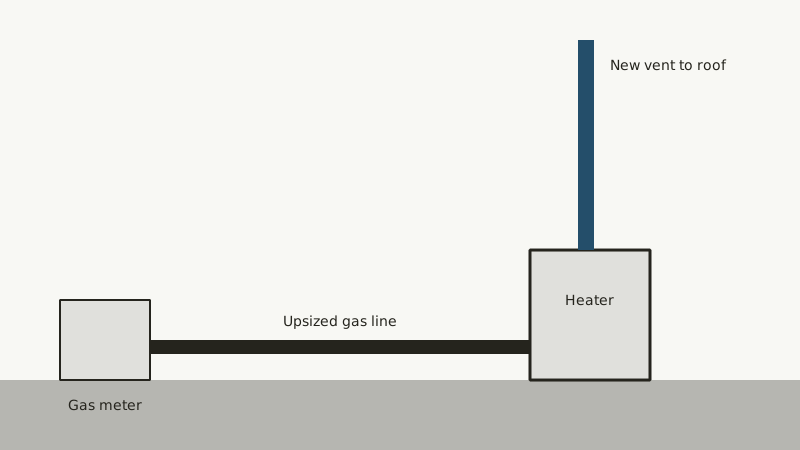
Houses near the harbor built across the 1920s to 1950s window frequently carry half-inch gas lines that served a stove and a small tank and nothing else. The plumber measures the run to the meter, adds up the appliances and quotes any upsizing separately. If the meter itself cannot supply the extra load, the gas utility has to be involved. Gas piping belongs to a plumbing contractor, as California insists on a contractor license for that kind of work, and the city inspects gas lines under a pressure test before anyone covers them.
Tank swaps carry their own code details. All water heaters in Long Beach must be strapped for earthquakes, a cold water shutoff must be at the heater, and the relief valve that vents excess heat and pressure may never be capped off or taken out. See gas shutoff valve and earthquake guidance for the related rules on the gas side.
Does fuel type change the answer: electric, natural gas or propane?
Yes. Natural gas gives the strongest tankless flow, electric tankless units usually deliver far less hot water per minute and can demand heavy circuits, and propane units work much like gas models though the fuel itself is pricier per unit of heat. Most Long Beach homes already have natural gas, so propane mostly matters for outbuildings and off-grid sites.
For electric homes, compare an electric tankless unit against a regular electric tank on three points: the panel capacity, the number of showers you run together, and the price per kilowatt hour on your bill. If the panel is full, the tank usually wins.
What can go wrong with a tankless heater, and who repairs it?
Mineral scale is the most common slow problem, followed by blocked burners or vents, error codes from sensors, and weak flow when the unit is undersized. A plumber flushes scale, checks the vent and gas supply, and replaces failed parts. Some repairs need the manufacturer's parts and codes, so the first visit is often diagnosis.
Hard water speeds scale, and sources recommend flushing a tankless unit on a schedule in hard-water areas. Ask your water supplier for its most recent water quality report so you know what your supply carries. The tankless gas heater repair guide walks through common faults, and the no hot water checklist helps you sort out a cold shower before you book a visit.
If you want numbers for your own house, request a quote and ask for both a tank and a tankless line item. Other jobs around the Harbor area are listed at Harbor Lights Plumbing.
Common questions
Does the higher price of tankless ever pay back?
Sometimes, if you stay put. Lower standby heat loss and a service life above 20 years, against ten to fifteen years for a tank, build the case. Offsetting that are the steeper install bill, a possible gas line upgrade and scale flushing, so a short stay or a very high-use household may never recover the premium.
Will a tankless unit leave you with a cold shower?
Not the way an emptied tank does, though it can still fall short. Open more taps than the burner can handle and the temperature sags or the unit shuts down. Match the unit to your busiest moment, and avoid running the dishwasher during showers, to keep the water hot.
Gas or electric: which tankless type is stronger?
Gas models push out more hot water per minute and fit larger households, yet they require a vent and frequently a fatter gas line. Electric models skip the vent but pull heavy current, so the panel gets checked first. In a home that already has natural gas, gas is usually the stronger fit.
Does a replacement tank need an expansion tank here?
Under the state plumbing code, an approved expansion tank belongs wherever the supply is a closed system, which means a regulator, check valve or backflow device sits on the incoming line. Inspectors look for the tank on heater permits. Ask the plumber whether your supply is closed, since a regulator is common.
References
- U.S. Department of Energy, Energy Saver Guide 2022
- U.S. Department of Energy, Building America tankless water heaters
- City of Long Beach, mechanical, electrical and plumbing code requirements
- City of Long Beach, permit questions
- Published installed-cost guides for tank and tankless water heaters from several consumer cost sites, checked November 2026
Updated