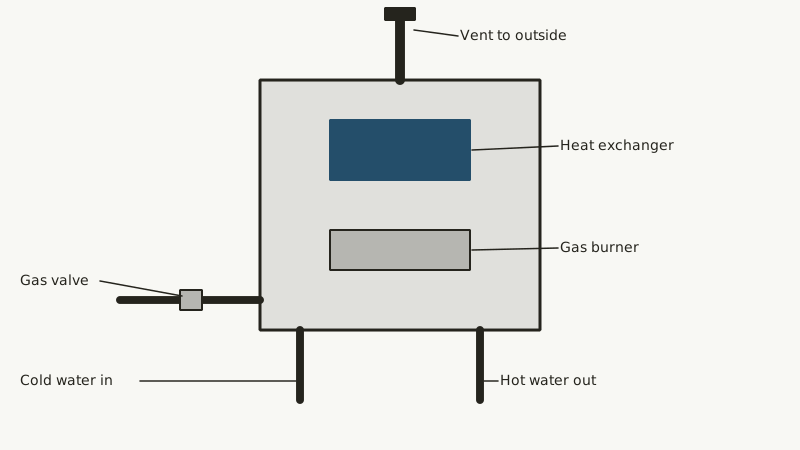
Nothing is stored in a tankless heater. It warms water on the way through, which takes a lot of energy at once: either a large gas burner or a heavy electrical service. That is why installation is the expensive part. Before any quote, a plumber looks at your gas line, venting route, wall space and panel. Our overview of water heater repair and replacement shows where tankless fits among the options, and this guide covers the install itself.
National cost guides put a tankless installation at roughly $1,404 to $3,904, with a 2026 average near $2,641. Treat that as a guide, since a Long Beach quote depends on what the walls and meters allow.
What has to be in place before a gas tankless heater goes in?
Three things: a gas supply big enough for the burner, a proper vent route to the outside, and a way to handle condensate if the unit is a condensing model. Federal energy researchers warn that a gas tankless unit can outgrow the existing gas line; in most cases the in-house line serving it has to be three-quarter inch.
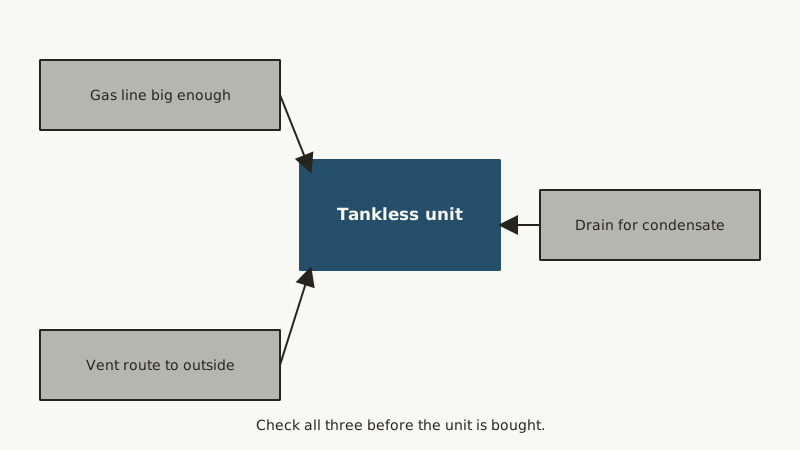
Gas tankless heaters add 175,000 Btu or more to a home's gas load, according to the same guideline, so expect a check of the meter capacity with the gas utility as well as the piping. Venting follows the manufacturer's instructions and local codes, using only listed vent materials, with the terminal clear of windows and other openings. Condensing units, which use a stainless steel heat exchanger and recover extra heat, produce condensate that has to be drained away properly.
Published cost guides list gas line upgrades from about $350 to $2,000, which is why the line is often the swing factor. If you are working out how a new line gets run, read our notes on gas line work.
What does an electric tankless heater need from my panel?
Heavy power. According to the DOE guideline, a whole-house electric tankless unit mostly runs on 208 or 240 volts and pulls anywhere from 50 to 200 amps by size; a few also call for extra circuits or a bigger service. An electrician checks the panel. Cost guides list a dedicated circuit at roughly $250 to $900, and a full panel replacement at about $850 to $1,700 if one is needed.
Electric units cost less to install because there is no vent or gas line, but they often flow less hot water than gas units, and running costs can be higher. In older Long Beach homes, the 1920s to 1950s bungalows especially, a small original panel can make the electrical side the deciding factor. A smaller point-of-use electric unit under a sink is a different, much lighter job.
What are the code requirements for a water heater in Long Beach?
The City of Long Beach requires a plumbing permit when water heating equipment is installed, altered, repaired or replaced. Its code page calls for a cold water shutoff, a T&P relief valve whose discharge pipe stops 6 inches to 2 feet off the ground, and an approved gas shutoff valve ahead of a flex connector no longer than 3 feet.
The city's strapping language is written for tanks, so a wall-hung tankless unit follows the maker's mounting instructions, and the plumber confirms what the inspector expects. Fuel-burning heaters are barred from sleeping rooms, and garage burners and switches have to sit a minimum of 18 inches off the floor. Most plumbing work needs a California contractor license. Leave gas piping and venting to the trades. San Pedro and Wilmington answer to LADBS, so their permit office differs.
Rotten-egg odor from gas piping? Step outside and keep walking. Once you are well away from the building, ring the gas company: Long Beach Energy Resources, (562) 570-2140, serves Long Beach and Signal Hill, while SoCalGas, 1-800-427-2200, covers most neighboring cities. Use 911 for anything that feels dangerous. For earthquake shutoff valves and what they do, see the gas shutoff valve guide.
Is a condensing tankless heater worth the extra cost?
A condensing unit extracts more heat from the exhaust, so it uses less gas for the same hot water. DOE lists efficiency of 0.92 or higher for condensing gas tankless units, against about 0.82 for conventional ones. The trade-off: a higher price, plastic venting and a condensate drain that has to be planned into the installation.
Condensing models suit a house where the vent can run in plastic pipe and a drain, such as a floor drain or the laundry standpipe, is close by. In a tight garage with no drain, adding one can raise the labor bill. Have a conventional and a condensing unit quoted together, then compare payback against the extra cost.
What if the taps run hot but the rooms stay cold?
In most American homes, water heating and space heating run on separate equipment, so one can fail without the other. If the taps are hot but rooms stay cold, the problem lies with the furnace, wall heater or thermostat, and a heating contractor is the right call. A tankless heater will not fix it.
Some homes pair a water heater with a coil for heating, called a combination unit, and the DOE guideline mentions those. If yours is one, tell the plumber, since a fault in one function can affect the other. If instead you have heat but no hot water, read about vanishing hot water and tankless units that run cold.
Do I need a professional to install a tankless unit?
Yes. Gas and electrical connections, venting and the permit all fall under California and city rules, and a mistake can cause carbon monoxide, fire or leaks. The plumber also picks the unit's size from the flow you need and the temperature rise, then sets it up so the manufacturer's warranty is not voided.
Do not buy a unit before the site is checked. A unit too small for two showers running together will disappoint, and one far larger than you need wastes money. Compare quotes on equal scope, and keep scale in mind: DOE advises flushing a tankless unit as the manufacturer directs, a schedule that ranges between twice yearly and every third year depending on model and water. Our page on tankless gas heater repair covers the common faults, and the installation cost guide breaks down the price. To get started, fill in the quote form.
Common questions
How big a block of time should I clear?
A straightforward swap when the gas line, vent and drain already suitable can take a few hours to a day. Upsizing a gas line, running a new vent through a wall or adding a circuit can stretch it over two days, with permit inspection to follow. The plumber gives a realistic estimate after seeing the site.
What goes on my checklist when comparing quotes?
Compare what each price covers: the unit, venting, gas line work, condensate drain, permit and haul-away. Learn who files the permit, what the maker's warranty demands and how the unit was sized. Look up the contractor license with the state board, and keep the details on paper.
Must I be present while it is installed?
Yes, for at least the start and finish. The plumber needs to walk the site with you, shut off gas and water, and explain the work. Expect a short outage, and clear access around the old heater and the wall where the new unit will mount. At the end, you will want a walkthrough of the unit's controls.
This guide is one of many on Harbor Lights Plumbing plumber.
References
- U.S. Department of Energy, Building America, Measure Guideline: Transitioning to a Tankless Water Heater
- City of Long Beach, plumbing code requirements
- Angi, how much does a tankless water heater cost (2026 data)
- Long Beach Utilities, gas service and emergency number
- California Contractors State License Board
Updated