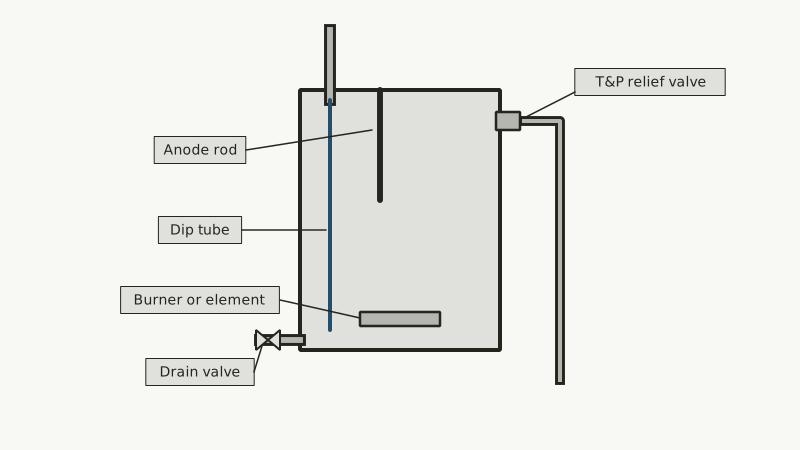
Count the years first. Federal energy guidance says a typical storage water heater is good for a decade or so up to 15 years, while a tankless model can reach past 20 with upkeep. If yours is inside that window, watch for symptoms. If it is beyond it, replace on your schedule instead of the heater's. Repair advice for younger units sits on our page about water heater repair.
A planned swap costs less and disrupts less than a tank that fails on a Sunday evening and floods a garage. The rest of this page gives you the numbers and the tells.
How many years does each kind of water heater last?
Department of Energy materials give a 10 to 15 year span for tank-type heaters and over 20 for tankless units. Its rulemaking analysis uses averages of about 15 years for storage and 20 for instantaneous models. Heat pump models are newer, so treat any figure for them as less settled and check the maker's literature.
Those are ranges, not promises. A tank in a mild, clean-water home with a fresh anode can pass the top of the range. One in a damp garage with sediment piling up may quit well under it. Tankless units do not hold a tank of water, so they corrode less, but scale inside the heat exchanger can still end them early.
If you are choosing between the two styles, our comparison of tank and tankless heaters lines up the trade-offs.
Where do I look to learn the heater's age?
Read the rating plate. Most makers stamp a serial number that hides the build month and year, and the code format differs by brand. Search the brand's name with "serial number age" or ask the plumber to decode it. A rusted or missing plate means falling back on purchase records or the date you bought the house.
In a Long Beach house that changed hands recently, ask the seller for the paperwork from the last replacement, since the city requires a permit for one. Older bungalows near Belmont Shore sometimes carry a tank from a previous owner that nobody has dated in a decade.
What warning signs say a tank is on its way out?
Water pooling around the base is the loudest. The rest of the list: brown-tinged hot water, popping or rumbling inside the tank, a smaller supply of hot water than last year, a relief valve that keeps dripping, corroded fittings, and a heater that cycles constantly. A leak from the tank shell cannot be repaired, only replaced.
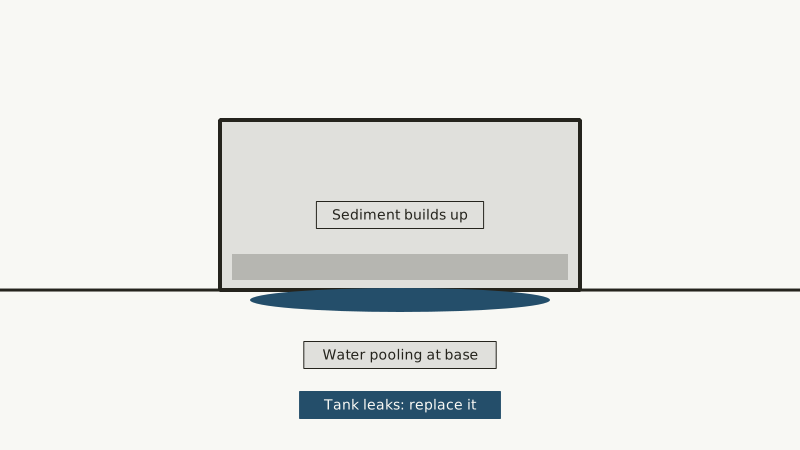
Rumbling means sediment has built up and water trapped beneath it is boiling. A flush can help a sound tank, so ask the plumber whether yours is a candidate. Rusty water only from the hot tap often points toward the tank, while rust from both taps often points toward old pipes. Our guide to a leaking tank covers the first moves when water appears.
Short bursts of lukewarm water can be a failed element or thermostat rather than a dying tank, so a plumber should check before you decide. The usual suspects are listed under hot water that disappeared.
What shortens the life of a heater near the harbor?
Hard minerals, salt air, skipped draining, a used-up anode rod, high water pressure and a cramped, damp enclosure all cut a tank short. You cannot change the weather, but you can service the tank. An anode rod swap, which sacrifices itself so the steel does not, is the most useful single step for a tank.
Heaters in coastal garages and side-yard closets see more corrosion on fittings and straps. High pressure strains the tank and the relief valve, so a pressure check is worthwhile; the write-up on swapping the anode rod explains what the rod does and when to swap it. Draining and flushing instructions are in the maker's manual for your model, so follow that rather than a generic schedule.
Should I replace it before it fails?
Often yes, once a tank is past about 12 years, especially if it sits above a finished floor or in an attached garage with living space nearby. A planned swap lets you pick the size, compare tank and tankless, handle the permit and avoid an emergency premium. A failing unit in the middle of the night gives you no options.
If the heater is younger and the problem is a part, repair makes sense. One common yardstick sets the repair quote against what a replacement unit would cost, and favors replacement when the fix eats a big share of it. Typical swap prices sit in our water heater replacement price guide. For urgent leaks, emergency water heater repair explains what to do first.
What does California require when I replace one?
Long Beach requires a plumbing permit when water heating equipment is replaced. The city's code also wants straps against earthquake movement on the top and bottom third of the tank, a T&P relief valve with a proper discharge line, an approved gas shutoff on gas models and a raised platform in garages. A contractor license is needed for most plumbing jobs in California.
Gas connections are not do-it-yourself work. Gas odor? Exit first. Reports go to your gas utility from the street: Long Beach Energy Resources at (562) 570-2140 for Long Beach and Signal Hill addresses, SoCalGas at 1-800-427-2200 for most other cities. 911 is for anything that looks dangerous. San Pedro and Wilmington use LADBS for permits, so the office differs there. Ready to line up a visit? Our quote page takes your details.
Common questions
Is 10 years too old for a water heater?
Not by itself. Ten years is the start of the typical window for a storage tank, so it is time to inspect rather than automatically replace. Look at the anode rod, check for leaks and rust, and note any drop in hot water. Plan for a swap within a few years.
Do tankless heaters really last 20 years?
They can, according to Department of Energy sources, which cite a life of more than 20 years. That assumes regular maintenance, mainly descaling in areas with mineral-rich water. A neglected unit with scaled heat exchangers can fail far earlier, and repair of the electronics may cost a lot.
Can I make an old tank last longer?
A little. Replace the anode rod before it is spent, flush sediment as the manual recommends, keep pressure within limits and fix small leaks at once. These steps stretch a healthy tank, but they cannot rescue one that is rusting through from the inside.
What should I do when the heater starts leaking?
Shut the cold inlet, kill the power or put the gas knob on pilot, and mop up. Water from the tank shell means a new heater. Water from a fitting or valve might be a simple repair, so let a plumber look before you assume the worst.
This guide is one of many on Harbor Lights Plumbing plumber.
References
Updated