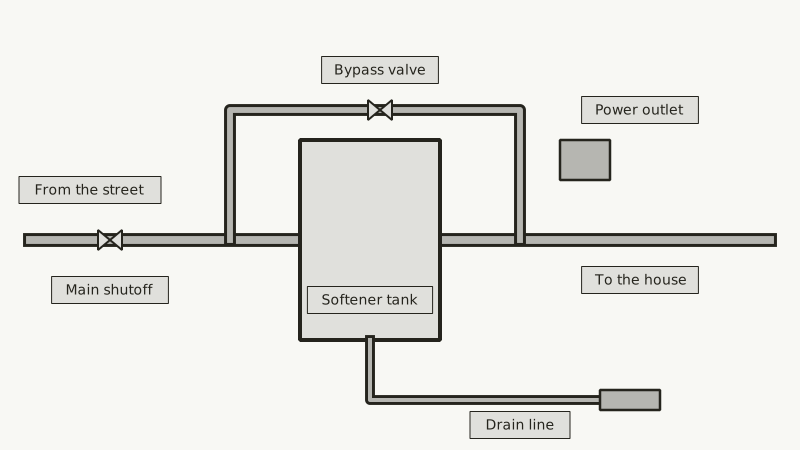
Installing a whole-house softener is not a plug-and-play job, even though the tank looks like an appliance. The tank taps the main water pipe, wants a drain and an outlet, and must be matched to your hardness and your daily consumption. Get any of that wrong and you pay for salt and wasted water without much softening. Below, the install in the order it happens, with the local rules a Long Beach owner should know. The wider softener plumber page explains how a visit is arranged.
Where does a softener get installed, and what gets connected?
It goes on the main supply after the shutoff and, usually, before the water heater, so every hot and cold line in the house receives softened water. The plumber breaks into the pipe, adds a bypass valve and unions, runs a drain hose for the recharge cycle, connects the power transformer and fills the brine tank with salt. Garages and utility closets are the usual homes.
Practical points shape the spot: a nearby floor drain or standpipe, an outlet, level floor space, and room to lift salt bags. Outdoor spigots and lawn irrigation are often left on a separate unsoftened branch, though that is a design choice to discuss. A plumber who walks the house before quoting is looking for exactly these items, and the quote should list them. The softened line also feeds the water heater, so an ailing heater deserves attention first; see water heater repair for that.
How is a softener sized for my house?
By how much hardness has to be removed between recharges. The rough method multiplies water use by hardness: a household using about 300 gallons a day at 12 grains per gallon removes around 3,600 grains daily, so a unit with a capacity near 25,000 grains would recharge about once a week. That is arithmetic for illustration only; a plumber sizes it from your actual numbers.
Your hardness figure comes from the utility. Long Beach Utilities' 2025 report lists a zone averaging about 12.8 grains per gallon and a blended zone averaging about 4.4. A house in the second zone may not need a large unit at all, and it may not need a softener, so confirm which zone serves your address before spending anything.
What permit applies, and who is allowed to install one?
In Long Beach a plumbing permit is required when water heating or treatment equipment is installed, altered, repaired or replaced, unless an exemption applies. The city's page does not name softeners explicitly, so confirm with the Permit Center, (562) 570-7648. Water conditioning equipment is named in the scope of C-36, the state's plumbing contractor classification.
California ties the contractor-license rule to a $1,000 threshold, counting labor and materials together. A resident owner in Long Beach can apply for a permit on personal work, yet breaking into the main and getting the drain right leaves little room for error. Learn whose job the permit is, who books the inspection and what the inspector checks.
Do any local rules restrict salt-regenerating units?
Possibly. Under Water Code 13148, some local agencies in the South Coast and other regions can limit salt discharged by self-regenerating residential softeners, though a regional water board must first find that doing so helps meet water quality goals. Measures can include permits, efficiency standards, or in some cases a ban on new installations.
So the question to ask is whether your sewer agency has adopted anything. We found no Long Beach restriction on the pages we checked, which is not proof that none exists. Ask the installer and the city, or put the question to the plumber you meet through our quote page. A high-efficiency, demand-initiated unit uses less salt and water than an older timer model, which helps wherever rules apply.
What happens on installation day?
First the main is closed and the line drained. Then come the bypass and connections, the drain run and the power, followed by the hardness setting, the recharge schedule, a brine fill and a trial cycle. Then the water is turned on, air is bled from fixtures and the system is checked for leaks. The inspector signs off later if a permit was pulled.
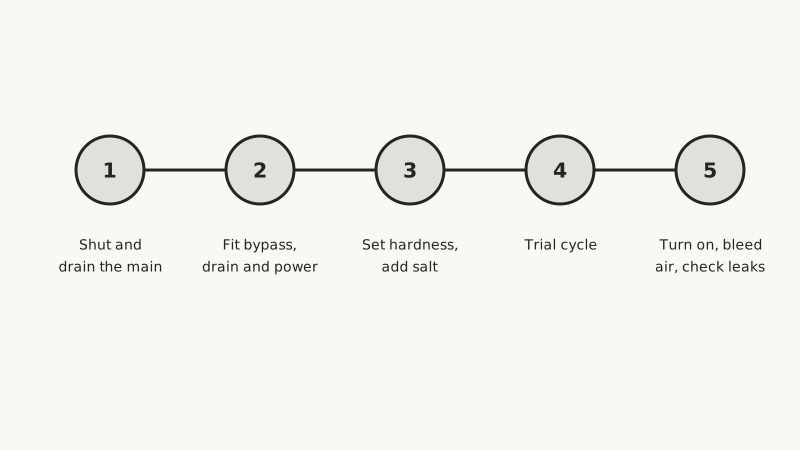
Installs commonly take a few hours to a day, depending on how easy the main and the drain are to reach. You will be without water for part of that. After installation, expect softened water to feel slippery, and expect to refill salt every month or two depending on use. Our softener cost page gives price guidance.
Salt softener or a salt-free system?
They do different things. A salt-based softener removes calcium and magnesium, which is what cures scale and soap scum. Salt-free systems are generally marketed as conditioners that alter the behavior of minerals while leaving them in the water. Results vary, and independent test data matters before you buy. If your goal is to stop scale for good, the ion-exchange softener is the proven route.
People on sodium-restricted diets often ask about drinking water. Softening adds sodium in proportion to the hardness removed, so mention it to your doctor and consider keeping a single drinking tap unsoftened. Before deciding, read what removes scale from fixtures, which shows what cleaning alone can do.
Common questions
Will the install take the whole day?
Plan on a day at most, and often only a few hours, provided the main and a drain are within reach. The permit inspection comes afterward and stretches the calendar, so get the plan on paper, including how any inspector's changes will be handled.
What belongs in the quote request for a softener?
Request the license number and classification, the model and capacity of the unit, how it was sized, whose job the permit is, the drain method, and whether outdoor taps stay hard. Itemize, compare two bids, and skip large deposits; a deposit may not pass $1,000, nor ten percent of a smaller contract.
Can I move or reuse an old softener?
Sometimes, if the tank and valve are sound and the capacity suits the house. A plumber should inspect the resin, valve and drain connection, and a worn unit is a poor bargain to install. Whichever way you go, the work still counts as installation or alteration of treatment equipment in Long Beach.
Could the softener cut my pressure?
A correctly sized and maintained one should not noticeably. A clogged resin bed, a blocked filter or a half-closed bypass valve can. If pressure drops after installation, tell the installer first. Other suspects are listed in what makes pressure drop.
This guide is one of many on the plumber guide for Long Beach.
References
Updated