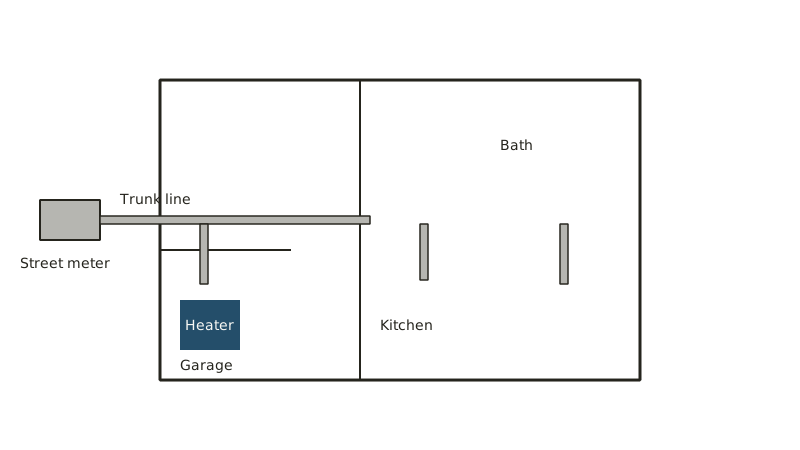
Roughly 17,500 houses went up in Lakewood between late 1949 and 1953, and the city says the plan was finished in 1953. That makes a typical Lakewood home about 70 years old, with original pipes of a similar age. Below, within the wider Long Beach and Harbor area we serve, is what that one building boom means for the pipes in your house.
Why do Lakewood homes tend to have the same plumbing problems?
Because most were built in one burst, with one set of materials and one generation of fixtures. At the peak a house was finished every seven and a half minutes, so builders used standard layouts and standard pipe. When that pipe ages, the same problems tend to show up down one street within a few years of each other.
Common age-related trouble in houses from this era includes pinhole leaks in copper, rust and low flow in any galvanized steel that survives, brittle shutoff valves and original heater hookups that have been patched more than once. I would treat these as patterns to check for, not predictions about your own house, since many have been repiped or partly updated over the decades.
Start with a visible check: stains at ceiling corners, green crust on copper joints, rusty water when the hot tap first opens, and pressure that drops when two fixtures run. Our guides on pinhole leaks in copper pipe and replacing galvanized pipe explain what each sign points to.
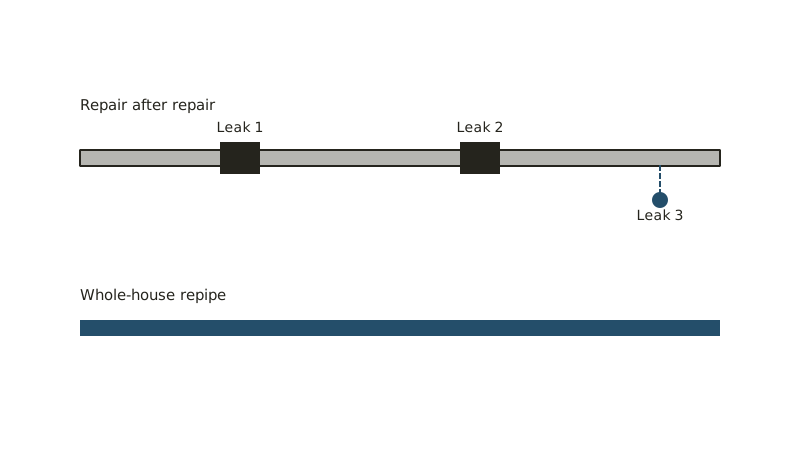
Whole-house repipe or repair after repair?
Once a home has had two or three leaks in the same pipe run, patching starts to cost more than it saves. A repipe replaces every supply run in the house during a single project. In a home this age, the real choice is often that or a string of drywall repairs.
Some postwar Southern California homes sit on concrete slabs, which makes a supply leak under the floor harder to reach. Ask the plumber whether your pipes run in the slab, in the walls or in the attic before you compare plans. Material comes next, and the comparison of PEX and copper weighs the options. For money, see what a house repipe costs, and for the process, how a repipe works.
Which water company serves your Lakewood address?
The City of Lakewood supplies most addresses from deep groundwater wells in the Central Groundwater Basin. About 6,000 households east of the San Gabriel River are served by Golden State Water Company instead, so the river is the dividing line, and your bill shows which one is yours.
The city report for 2025 says the supply is 100 percent groundwater from 11 deep wells, with a standby connection to imported supplies for emergencies. Hardness averages 7.13 grains per gallon, ranging from 5.1 to 8.88, which counts as moderately hard. Even moderately hard water leaves scale inside a tank heater over time. For Golden State Water addresses, the company's own report is the source, and the city page gives its number, 1-800-999-4033. Either way, the notes on dissolving scale apply.
Who handles plumbing permits in Lakewood?
The City of Lakewood's Building and Safety division handles them, mostly through its online OpenGov portal. Its permits page lists plumbing work among projects that often begin with a permit. Counter hours are Monday to Thursday, 7:30am to 4:30pm, plus alternating Fridays, and the phone is 562-866-9771, extension 2350.
A contractor license is generally required in California for this work, and the state board's lookup tool is at cslb.ca.gov. The permit page never says whether swapping a water heater needs one, so ask the division that one directly. We would rather you ask the city than rely on a guess. If a plumber says no permit is needed, ask where that rule comes from.
How do you handle a gas leak in Lakewood?
Everyone out of the house first. Danger of any kind means 911. Lakewood gas generally comes from SoCalGas, so once outside, the number is 1-800-427-2200, though your gas bill confirms the supplier, since a few nearby cities differ. In Long Beach and Signal Hill the number is instead Long Beach Energy Resources, (562) 570-2140.
Leave switches alone, and keep car engines off in an attached garage. Gas lines belong to contractors, and the work usually needs a permit. Once everyone is safe, the page on a sewer smell indoors helps if you cannot tell gas from drains. A separate page covers the valve that cuts gas during a quake.
Does the layout of Lakewood affect how a plumber works?
Not much. Lakewood's boulevards have frontage roads on both sides and only occasional collector streets, so addresses can be awkward to find the first time. Heaters in single-story homes usually sit in a garage or closet, which keeps them easy to reach.
Tell the plumber the cross street and which side of the frontage road you are on, and where the heater is kept. Ask about the pressure regulator too, since a worn regulator stresses fixtures and is a quick thing to check in an older home.
What does plumbing cost in a Lakewood tract home?
The written quote will depend on how old the pipes are, whether the work touches a slab, and whether a permit comes into it. We do not publish a Lakewood price list. Ranges drawn from public sources are on the plumber cost page.
Fastest is the quote form. Mention the 1950s build, which tells the plumber to plan for older fittings. A plumber visits and writes the quote up before any work. Weekday phone hours run 9am to 5pm.
Common questions
Do 1950s Lakewood homes need repiping?
Not automatically. Many have been repiped or partly updated, and copper can last decades. The signs that point toward it are repeated pinhole leaks, rusty hot water, falling pressure and stains in ceilings. A plumber who inspects the lines can say whether repairs or a full repipe makes more sense, and the written quote lays out both.
Is the water hard in Lakewood?
Moderately. The city's latest report averages 7.13 grains per gallon, spread between 5.1 and 8.88, all from its own deep wells. About 6,000 households east of the San Gabriel River are served by Golden State Water, whose figures differ, so check which company bills you before you buy a softener.
What number do I call for gas in Lakewood?
Get outside, use 911 for any danger, and from the street, SoCalGas is 1-800-427-2200. That utility generally supplies Lakewood, though your gas bill is the final word. In Long Beach and Signal Hill the emergency number is Long Beach Energy Resources at (562) 570-2140, so use the number that matches the address.
Does a replacement water heater in Lakewood need a permit?
The city lists plumbing work among projects that often begin with a permit, but never names water heaters. Phone Building and Safety on 562-866-9771, extension 2350, before the job begins. A contractor who files permits regularly should know the answer already.
This area guide is part of plumber in Long Beach.
References
Updated