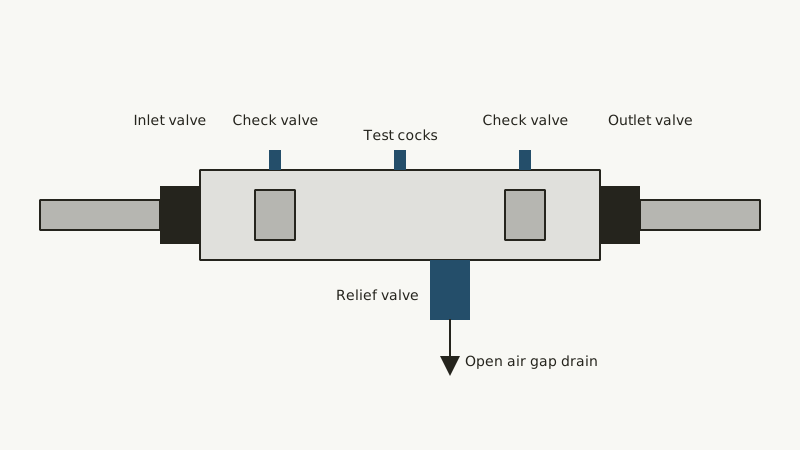
If your shop, restaurant, office or industrial unit has a backflow assembly on the water service, California expects an annual field test on it, performed by someone the water system recognizes. A commercial plumber from the area can run that test after we set up the visit. Wider business plumbing topics live on the commercial plumbing hub.
Why does a business need its backflow assembly tested every year?
A backflow assembly is a spring-loaded valve set that stops used or contaminated water from drifting back into the public supply. Springs weaken and seats foul, so the device can fail without any sign at the faucet. The state's cross-connection handbook responds by calling for a field test every year, and sooner where the hazard runs high.
The danger is real in a working building. Dishwashers, carbonated drink systems, boilers, irrigation, chemical mixers and fire sprinkler lines all connect to potable water. If supply pressure drops in the street, for instance during a main break or heavy fire flow, whatever sits downstream can be drawn backward. An assembly that passes its test is the only barrier in that moment.
Long Beach's Health Department runs the city's cross-connection program and publishes a list of approved testers and a sample test form on its website. Water suppliers vary across the Harbor area, with Long Beach's own utility serving most of the city and Los Angeles serving San Pedro and Wilmington, so the first call is to whoever sends your water bill.
Which testers may sign off a commercial device?
The required test belongs to a tester whose credential comes from an organization the State Water Board recognizes, and your water supplier decides which testers it accepts. A general plumber without that credential can install or repair an assembly but cannot sign off the annual test. Ask for the tester's number and check it against your supplier's list.
When you book:
- Confirm that the person is on the water supplier's or Long Beach Health Department's list, not just that the company says so.
- Ask which gauge the tester brings and when it was last calibrated, since the handbook expects test equipment to be verified for accuracy each year.
- Request a written report, because the supplier usually wants the form, not the invoice.
How does the test itself run on site?
The tester clips a calibrated gauge to the assembly's test fittings. The tester closes the water for a spell and reads whether both check valves and the relief valve hold at the pressures the design calls for. One device normally takes under an hour, with water interrupted meanwhile, so book it outside peak trading hours.
Here is what to prepare:
- Access. The assembly must be reachable, with room for the tester and a drain path. Locked cages, overgrown shrubs and shelving stacked in front are the usual hold-ups.
- A water shutoff window. Tell kitchens, salons and clinics ahead of time.
- The device list. One building can have several assemblies: domestic, irrigation, fire line and process equipment. Each gets tested and reported separately.
- Past reports. They show serial numbers and last pass dates.
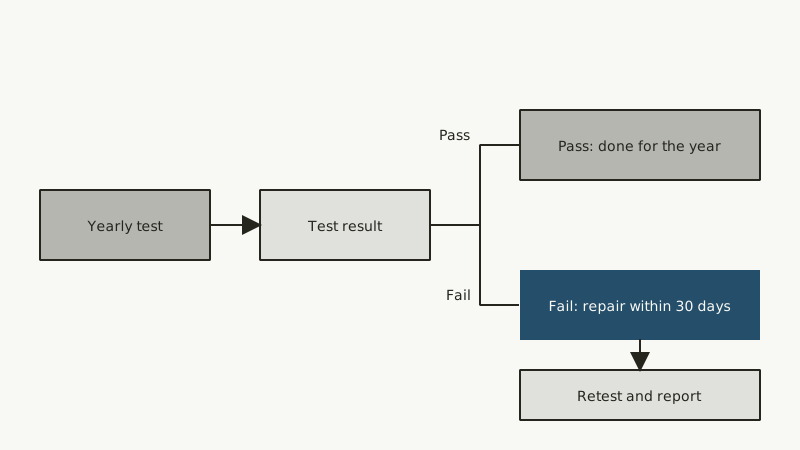
After the test, the tester records results on the form and sends a copy to the water supplier. A pass means you are finished until next year. A fail starts a clock.
What if the assembly fails?
Under the handbook, a device that fails must be fixed or swapped out within 30 days of the notice, although a water system can allow extensions under its own plan. The usual culprit is a dirty check valve or tired rubber seat, which a rebuild kit cures. Once repaired, the device is retested and the new passing result goes to the supplier.
Do not wait on a failed device. A supplier that suspects backflow can shut off service until a passing test is received, and a business without water cannot trade. If the unit is old, corroded or the wrong type for the hazard, swapping the unit can cost less than rebuilding it again and again, and the plumber should explain which case applies. For irrigation lines specifically, see our sprinkler system testing guide, and for a general overview of the topic, the backflow prevention testing page.
How much does commercial backflow testing cost?
Published guides put a commercial annual test at roughly $100 to $400 per assembly, depending on the device type and size, with larger reduced-pressure units at the upper end. A rebuild after a fail commonly adds a few hundred dollars, and a full replacement runs higher. Sites with several devices may negotiate a bundled price.
| Item | Guide range |
|---|---|
| Annual test, one small assembly | about $100 to $250 |
| Annual test, larger reduced-pressure unit | about $175 to $450 |
| Repair or rebuild after a fail | about $200 to $800 |
| Replacement of a commercial assembly | often $500 to $1,500 |
Those figures come from published price pages rather than a quote. The written estimate from the plumber, after seeing your device, is the number to trust. For labor rates that apply to other commercial work, check the commercial hourly cost page.
What else does a commercial plumber handle?
A commercial plumber handles piping for businesses: restroom groups, kitchens and grease traps, water heaters sized for many users, fire line connections, gas to rooftop and kitchen equipment, and emergency repairs. Compared with home service the pipes are larger, the codes stricter and the downtime costlier, so planning matters more than speed.
To ask about testing at your site, list every assembly you know of in the quote form. Everything else we handle is outlined on the Harbor Lights Plumbing front page.
Common questions
How often must a business device be tested?
Yearly, per the state handbook, plus after any installation, repair or relocation. A water system or health agency may demand more frequent tests where the hazard is high or a device has a history of failing. Check your supplier's letter, since it sets the date and the form.
Can my regular plumber test the assembly?
Only when that person holds a recognized tester credential and appears on your water supplier's list. Many plumbers can install and rebuild assemblies but are not on the list. Ask for the tester number before booking, because a test done by someone outside the list may be rejected by the supplier.
What does a failed backflow test mean for my business?
It means the device did not hold pressure as required. The water system expects repair or replacement within 30 days of notice, and it may close service if backflow is suspected. Repair is often a rebuild kit and an hour of labor, followed by a retest and a new report.
Do I need testing if I only have an irrigation line?
Often yes. Landscape irrigation connected to drinking water commonly carries an assembly, and it falls under the same annual test rule when the water system requires protection at that connection. Check with your supplier, and see the sprinkler testing guide linked above for the specifics.
References
- California State Water Resources Control Board, Cross-Connection Control Policy Handbook (adopted December 2023), section 3.3.3
- City of Long Beach Health, Cross-Connection Program
- City of Long Beach, mechanical, electrical and plumbing code requirements
- Published backflow testing price guides from several testers and suppliers, checked November 2026
Updated