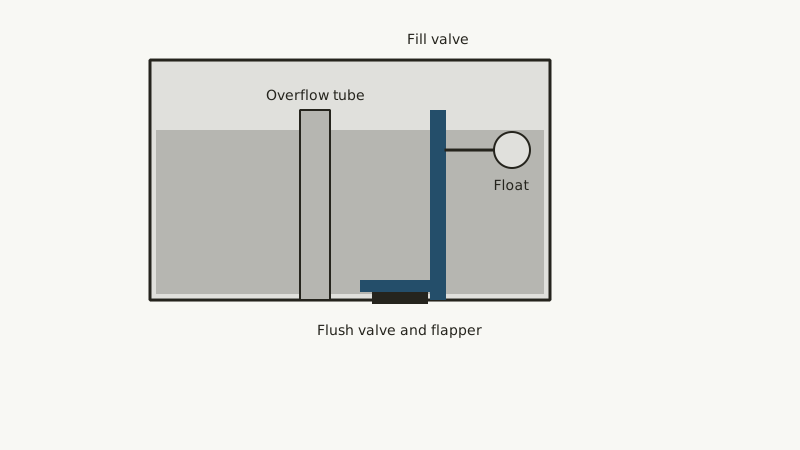
Lift off the porcelain lid and you can often see the fault: a flapper hanging open, a chain that is too slack or too tight, a float sitting high, or a lever lifting nothing. Most of the parts involved cost under $20. Bowls, seats and supply lines belong to the wider toilet repair overview; this page stays inside the tank and at the handle.
What makes the tank top itself up over and over?
Suspect the flapper first. That rubber seal sits over the drain hole at the tank floor, and once it warps, hardens or catches on its chain, water slips past into the bowl, the level falls, and the fill valve keeps topping the tank up. The same thing happens when the fill valve never closes or the water rises beyond the lip of the standpipe.
Sort it out with the lid off. Press the handle and watch. Water slipping by the flapper points to the seal. A brim-full tank that still spills down the standpipe means either the float setting is wrong or the fill valve has quit. To expose a leak you cannot see, put a few drops of dye into the tank, wait about fifteen minutes, and peer into the bowl. The longer diagnosis is in our piece on a running toilet.
Which tank part gives out first, and what does each one do?
Five parts matter. The flush valve is the big outlet in the tank floor, plugged by the flapper until the handle moves. The fill valve (ballcock, float valve) refills the tank, guided by a float. The overflow tube is the safety standpipe. The handle moves a chain or arm that lifts the flapper.
Flappers die first. According to Wikipedia's entry on the flush toilet, they commonly start leaking after a couple of years, and the EPA suggests replacing one at least once every five years. Local water shortens that: the utility's 2025 water quality report lists a zone averaging roughly 12.8 grains per gallon, and a mineral crust on the seat can stop even a brand-new flapper from sealing. Fill valves are next in line, then chains and handle arms. The valve body itself seldom fails unless it cracks or corrodes.
Can I swap the flapper or reset the float without a plumber?
Yes. Twist the stop valve under the tank closed, flush to empty it, and sponge up the last puddle. Unclip the chain, take the worn flapper off its pegs, snap a matching one on, and reconnect the chain with a touch of play. Reopen the stop valve, then flush a couple of times while you watch. Adjust the float so the tank stops filling roughly one inch below the rim of the standpipe.
Take the old flapper along when you shop; shapes and sizes vary. Rub the seat it rests on with a scrub pad until it feels smooth. Some floats adjust with a screw or clip, and others slide along a rod. Steps for each part appear in our write-ups on flapper repair and fill valve replacement.
The handle feels loose or does nothing. What is wrong?
Look at the chain first. A long one keeps the flapper from rising all the way; a tight one stops it from ever sitting down. A handle that spins freely probably has a slack mounting nut inside the tank, and that nut has a reversed thread, so it tightens counterclockwise. A bent arm or a snapped lever calls for a new handle set, usually a part under $20.
When the lever works but the flush is feeble, look at the tank level, how far the flapper opens, and the small rim jets beneath the bowl's lip, which scale can clog. A bent wire clears them, and vinegar softens crust. In an old low-flow model, a thin flush may simply be the design. More variations on the handle problem appear in the guide to a loose handle that will not flush.
Is it time for a new flush valve instead of an adjustment?
Do so if the seat has pits or a crack, when moisture appears around the base where the valve meets the tank, or when a fresh flapper on a scrubbed seat still leaks. The work involves removing the old assembly and fitting a new one, usually with a fresh rubber seal where tank meets bowl. Plenty of homeowners hand that task to a pro.
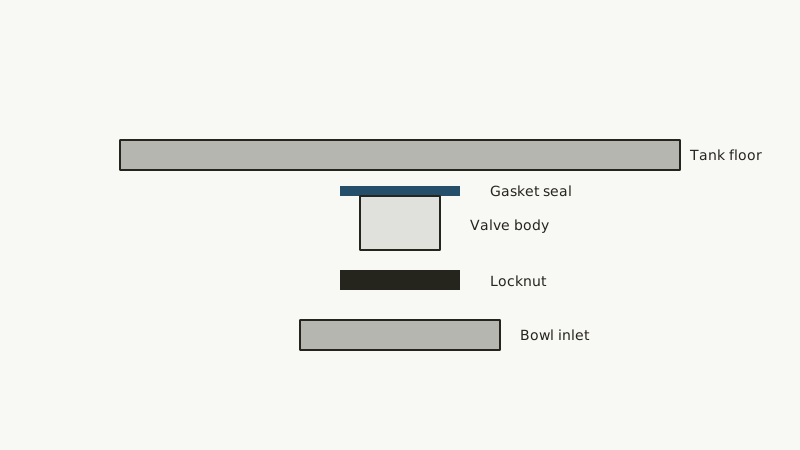
On certain models, a repair kit slips over the old valve so the tank can stay bolted to the bowl, which shortens the visit. Whether that works depends on the toilet. Our guide to replacing the valve with the tank left bolted down explains which toilets qualify, and a split standpipe is its own repair under overflow tube repair.
How much do these repairs run?
Thumbtack's October 2026 national figures show toilet repairs averaging $149 to $355, with most customers near $230, a floor of $81 and a ceiling of $665. Flapper and fill valve parts are about $5 to $20, a plain handle under $20, and fancy trip levers $50 to $100. Those are ballpark numbers, and only the quote gives the real figure.
Labor explains the spread. A flapper swap is minutes, so many plumbers wrap it into a bigger visit or bill a minimum. Fill valves and flush valves take longer. Putting it off costs more than fixing it. The EPA says an old toilet traded for a WaterSense model can save close to 13,000 gallons a year, while one tired flapper can lose a few thousand.
When is it smarter to book a visit?
Book one when a part will not turn or thread, when the tank is cracked or drips at its bolts, when the stop valve under the tank refuses to close, or whenever taking the tank apart is not how you want to spend a Saturday. In Long Beach, minor repairs with approved parts are exempt from a permit, whereas replacing a fixture generally needs one.
A stuck or weeping stop valve is a job of its own, covered in shutoff valve repair for toilets. Never force an old one, since a snapped stem floods the room. If you want someone to come out, the quote page is where to ask. Our other trades are shown on the Harbor Lights home page.
Common questions
Which part usually causes a toilet to run on?
The flapper, by a wide margin. Chain length, the fill valve and an over-high float come after it. Food coloring in the tank tells a leaking flapper apart from an overfilling tank at almost no cost. Try a new flapper first, because it is the least expensive piece.
Is a running toilet something I can ignore for now?
For a short while, yes, but it wastes water and pushes up the bill. Waste adds up quickly, and a unit that never stops also wears out its fill valve. If a repair has to wait, close the stop valve between uses.
Rim holes are clear and the flush is still weak. Why?
Begin with the tank level, since a low one starves the bowl. Next, see how far the flapper opens and whether the chain pulls evenly. When both look right, a partial blockage in the trap or drain may be thinning the flush, and a camera or snake can find it.
Does the entire toilet need replacing?
Rarely. With sound porcelain, parts run a sliver of what a new toilet costs. Replace the unit when the bowl or tank has a crack, the model is ancient, or repairs keep failing. New toilets are limited to 1.6 gallons a flush, and WaterSense ones to 1.28.
References
Updated