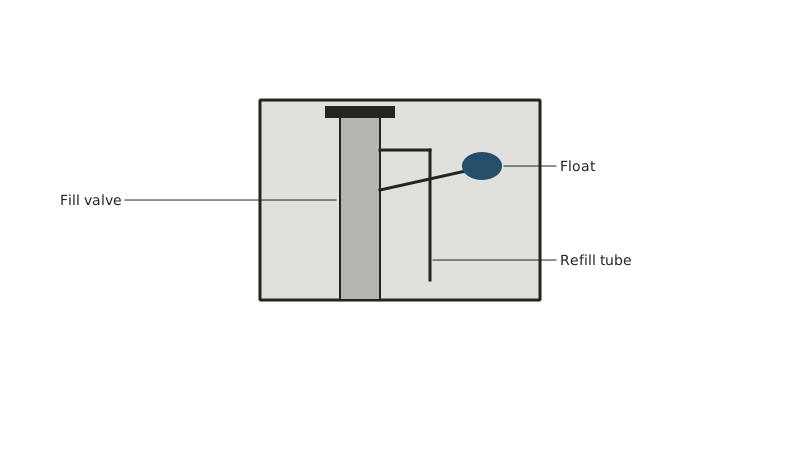
The fill valve is the upright column in the tank's corner, open while the tank refills and closed once the water hits its mark. Once it wears out, you get hissing, a tank that never quits filling, or a thin stream circling down the overflow tube. The part costs about $10 to $25 and goes in within half an hour. Other toilet faults are on the toilet repair overview.
Is it really the fill valve acting up?
Look for hissing after the tank is full, water trickling into the overflow tube, a tank that fills sluggishly or not at all, or a water level that wanders. A leaking flapper behaves differently: the tank slowly empties, then refills by itself, while the fill valve looks fine.
Lift the lid and watch for a minute. Water spilling in across the rim of the overflow standpipe says the valve cannot shut off. A level well below the overflow, with the bowl still draining, implicates the flapper. For a dye test, color the tank water with a little food dye; the EPA says to wait about ten minutes, and tinted bowl water confirms a flapper leak.
Both parts are rubber and about the same age, so they tend to fail together. Kits often bundle them, which is why the toilet flapper guide makes sense as a companion to this one.
What does a constantly running toilet cost me?
EPA WaterSense cites roughly 200 gallons a day for an average running toilet, about 30 gallons for a small leak, and far more when a fill valve sticks wide open. Dollar costs depend on your utility's rate, but a persistent leak can add tens to hundreds of dollars a year.
Notice your bill first. If usage climbed while nobody was home more, check the toilets before anything else. A meter test confirms it: close every tap for two hours, and a dial that moved gives you a leak. Other culprits are listed under reasons a water bill spikes. EPA puts the all-leaks household average above 9,300 gallons yearly, and one toilet can be a big slice of that.
What do I need to swap the valve, and what are the steps?
Pick up a universal fill valve for about $10 to $25, plus a sponge, a towel, slip-joint pliers and a small bucket. The sequence runs: close the supply, empty the tank, uncouple the hose, back off the locknut, lift the old valve out, seat the new one, reconnect, then set the float.
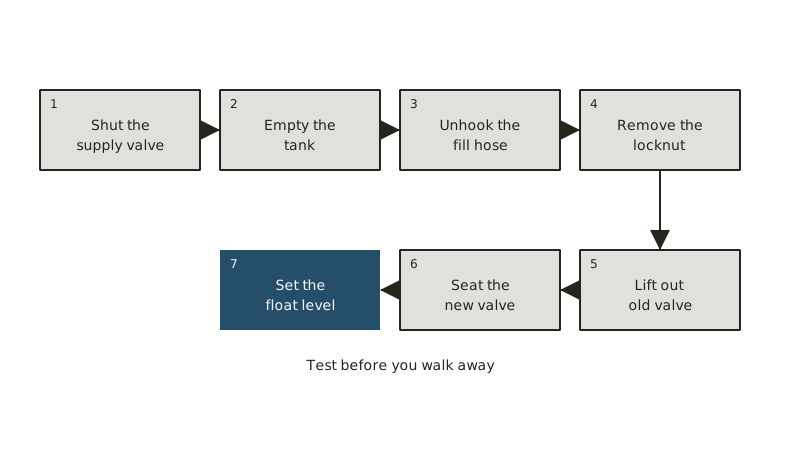
Here is the order:
- Rotate the shutoff, found at the wall or in the floor, clockwise to its stop.
- Flush, hold the handle down to drain the tank, and sponge the remaining water.
- Unscrew the coupling nut that attaches the supply hose to the valve's shank, with the bucket underneath.
- Spin off the big plastic locknut beneath the tank, then lift the old valve free.
- Drop in the replacement and adjust its height until the top stands roughly an inch above the standpipe. Snug the locknut by hand only, since plastic cracks under a wrench.
- Reattach the hose, snap the slim refill tube onto the standpipe's rim, and open the shutoff gradually as the tank fills.
- Adjust the float, by screw or slide, until the water stops at the fill line printed inside the tank.
Flush three or four times and check both fittings under the tank for drips. A shutoff stuck open, or one weeping at its stem, is the signal to stop and ring a plumber. Forcing it can break the valve. Shutoff valve repair is its own topic.
Is this a good time to replace the flapper, or a gasket?
Yes, when the flapper has years on it. EPA guidance calls for replacing that rubber stopper seal low in the tank at least every five years, since a tired one leaks silently and can waste thousands of gallons annually. It costs little, and the same shutoff-and-drain routine applies.
Carry the worn flapper, or a phone photo, into the shop so size and style match, and look for a float arm. When people search for a flapper gasket, they usually mean the flapper, or the rubber gasket joining tank to bowl. The latter drips at the tank base and calls for lifting the tank off, which is a bigger task than a fill valve. A toilet that rocks or leaks at the floor may need a new wax ring; our toilet replacement cost page touches on that.
Why do supply lines burst, and how old is too old?
The flexible hose from the shutoff to the tank can split, and it will pour water until someone closes a valve. Sources suggest replacing braided lines every five to ten years, sooner if the braid frays, rust appears, a bulge forms, or the nuts feel damp. A new hose runs about $10 to $25.
That hose, not a pipe inside the wall, is what people mean by "toilet burst pipe". Since the line is already off during a fill valve swap, replace it. Know where your main valve sits, too. Cottages near Belmont Shore built before 1960 may have a corroded shutoff that will not turn, which justifies fitting a quarter-turn valve. Altering supply piping falls under Long Beach plumbing permit rules, with minor repairs excepted, so let a plumber judge it.
If water is spraying and nothing closes, go to the whole-house shutoff, then see first steps in a plumbing emergency.
Common questions
How long will I be at it?
On a first try expect 20 to 30 minutes, plus waiting for the tank to refill and tuning the level. A plumber usually moves faster. A seized or corroded shutoff can drag things out, and that one is best left to a plumber instead of being forced.
Is a plumber much dearer than doing it myself?
Guides span about $75 to $240, shaped by the trip fee and by whether the flapper and hose join the job. A parts kit alone is $20 to $50. Those figures come from other publishers, so get the plumber's own price in writing first.
Is this a safe do-it-yourself job?
For most people, yes. It takes ordinary hand tools and no soldering. Pass it to a plumber when a shutoff will not budge, the supply hose is corroded onto its fitting, or the toilet itself is cracked or leaking at the floor.
Do I need to be around for a plumber's visit?
Have an adult available to unlock and show the toilet. Visits tend to last under an hour. Clear the area beside the bowl, and say whether the tank also leaks or the handle sticks, so the right parts ride in the truck.
This guide is one of many on the plumber guide for Long Beach.
References
- US EPA WaterSense, fix a leak, toilet leak test and flapper advice
- City of Long Beach, plumbing permit requirements
- Published toilet fill valve and supply line cost guides from several plumbing and home improvement sites, checked November 2026
Updated