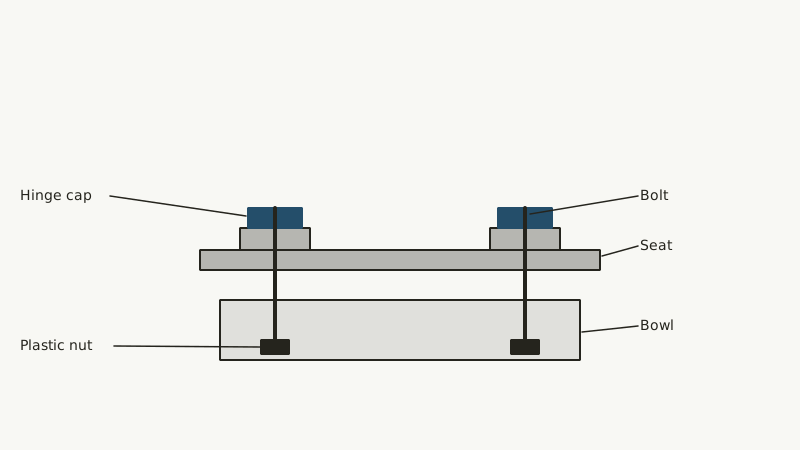
Flick up the small hinge covers behind the seat and look beneath them: what you find decides the repair. A slid-around seat almost always means the two mounting bolts have worked loose, and snugging them fixes it in minutes. If a bolt only spins, the plastic hardware has stripped, and a hardware kit costs less than a new seat. A wobbling bowl is a different matter and belongs in the toilet repair guide.
What lets a toilet seat drift out of place?
Two bolts through the back of the bowl hold the seat, and daily use rocks them loose over time. Worn or stripped plastic nuts, a seat that does not match the bowl, or hinges that have shifted all let it drift. Bemis, a seat maker, says a loose or shifting seat usually traces to loose bolts or worn fasteners.
Seats get used hard: sitting, standing on the lid to reach a shelf, cleaning, and the slamming of lids. Tightening alone may not last if the nuts are cracked. A seat that is the wrong size or shape for the bowl will not sit centered, so check that round and elongated bowls get matching seats. Damp coastal air can rust metal hardware, and some cleaning products make plastic brittle, so bolts in a steamy bathroom may need more frequent attention. If your seat also sits crooked or the lid slams, look at the hinge type, since some allow adjustment.
What kind of mounting do I have?
Snap the hinge covers open. Most seats use a bolt that goes down through the hinge and bowl and is held by a plastic nut underneath, a bottom-mount. Others fasten from above with a screw into an anchor in the bowl, so there is nothing to reach below. Many have a cone or wing nut that grips by itself.
Kohler's standard-seat instructions describe the typical arrangement: bolts through the hinges from the top, plastic nuts threaded on from below, a rubber washer between hinge and china, and tightening from above like a screw, holding the bolt if needed. Quick-Attach hardware, as used on some Kohler seats, grips differently, and Kohler gives separate instructions for it. Look under the rim with a flashlight or a phone camera if you cannot see the nuts. Knowing the type tells you whether you will need to hold a nut with pliers.
How should I tighten the mounting bolts?
Open the caps, keep the seat straight and centered over the bowl, and turn each bolt clockwise with a flat screwdriver. If the bolt spins, reach below the rim and hold the plastic nut with your fingers or pliers while turning. Work both sides evenly until nothing shifts, then quit.
Go slowly. Bemis warns against overtightening, which can damage the seat or the bowl, and heavy force can crack the plastic or the china around the hole. A quarter-turn past snug is plenty. Finish by pushing the seat sideways to test it. If one bolt tightens and the other still spins, the loose side has stripped hardware. A rubber washer between the hinge and bowl, as in Kohler's instructions, helps keep the seat from creeping. Finally close the caps.
The bolts just spin. What now?
Then the plastic nut or the bolt threads are stripped. Hold the bolt from above, back the nut off from underneath, and look at both. Replace the pair with a hardware kit made for your seat's brand, or fit a new seat if the hinges are cracked. Do not force a stripped part to bite; it will fail again.
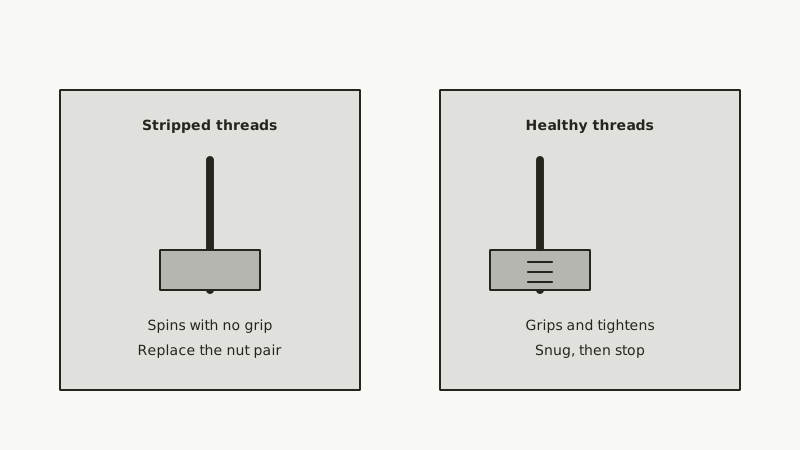
Seat hardware kits are inexpensive, and some are designed to resist loosening, as with Bemis's Stay-Tite system, which the company says is built to hold. Carry the old bolt and nut to the store to match size and style. If the bowl's mounting hole is cracked or chipped, the seat will not hold and the fixture may need replacement; the toilet replacement cost page has figures. A basic seat runs about $40 to $50 according to Thumbtack's October 2026 guide, while hardware kits cost far less.
Can I adjust a seat that sits crooked?
Often yes, if the hinges are adjustable. Loosen the bolts slightly, slide the seat so it sits evenly over the bowl rim with the same gap on each side, and retighten. Bemis says many adjustable hinges allow front-to-back or side-to-side movement to correct misalignment.
Center it by eye from above, then check that the lid lands flat. A soft-close lid that starts to slam may have hinge damage or something blocking it, according to the same source. Replace the seat if the hinges are warped. When shopping, match round versus elongated to the bowl, and confirm the bolt hole spacing against the package, since it usually matches but not always.
Could the whole toilet be loose, not just the seat?
If the seat is fine but the whole bowl rocks, the problem is at the floor: loose or corroded closet bolts, a failing wax seal or an uneven floor. Treat this one seriously: a bowl that rocks can break its seal and leak onto the subfloor. Check for damp around the base.
Rocking and leaking at the base are discussed in water at the base of a toilet, and a plumber can reset the bowl with a new seal. The City of Long Beach says a permit applies when a fixture is installed, altered or replaced, apart from narrow exceptions, so when the bowl has to come off, find out if the work needs one. Thumbtack's October 2026 guide puts a simple toilet repair at about $100 to $250 nationally. If a handle that feels loose is your problem instead, see a toilet handle that is loose and will not flush. A plumber can be requested on our quote page, and the full range of work is on the Harbor Lights home page.
Common questions
How tight should toilet seat bolts be?
Snug enough that the seat does not shift when you push it sideways, and no tighter. Hand-tight with a screwdriver, plus a small extra turn, is the usual stopping point. Overtightening can crack plastic hardware or the porcelain, so go slowly and test the seat after each turn.
Why does my new toilet seat keep coming loose?
The nuts may be starting to strip, the bolts may be the wrong length, or the seat may not match your bowl. Make sure the seat is centered when you tighten, and add the rubber washer if one came in the box. Some people choose hardware that grips the bowl more firmly.
Will any seat fit any toilet?
No. Round and elongated bowls take different seats, and the spacing of the bolt holes and the hinge positions vary between makes. Measure the bowl or look up its model before buying. A seat that sits slightly off keeps sliding, however tight the bolts are.
What is the time cost of tightening a seat?
Roughly ten minutes for plain tightening, and 15 to 30 if you swap hardware or the whole seat. No need to shut off the water, since the tank and supply line are untouched. Keep a flat screwdriver and a pair of pliers within reach.
References
Updated