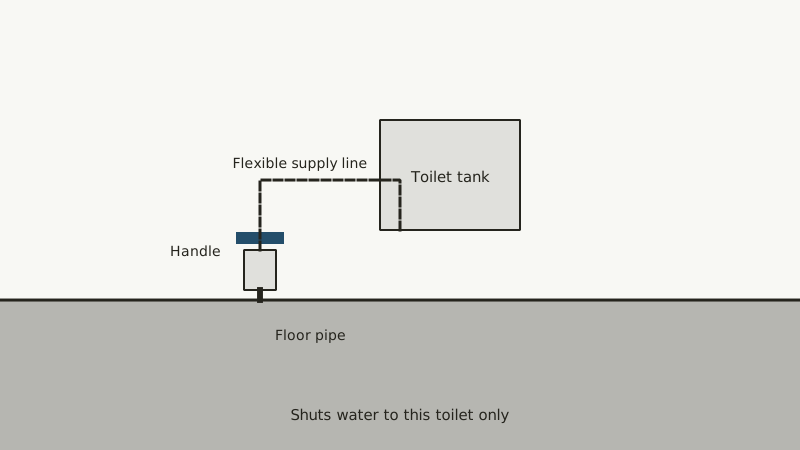
Every toilet has a stop valve, a small fitting on the supply pipe at the wall or floor that lets you cut the water to that one fixture. It matters most on the day something else goes wrong, a tank leak or a flapper repair. When the stop valve itself drips or refuses to turn, you have a small plumbing job with a large flood risk. Everything else about the fixture is in the toilet repair overview; this page deals with the valve alone.
What does the valve behind the toilet do, and what kinds are there?
It closes the water supply to the tank so a toilet repair does not mean cutting water to every tap in the building. Most are angle stops: a pipe emerges from wall or floor, the valve turns the flow ninety degrees, and a flexible line climbs to the tank. The old style takes several turns of a round handle. Newer ones are quarter-turn valves.
Older multi-turn valves seal with a rubber washer that hardens, and a packing nut around the stem that can start to weep. A quarter-turn ball valve has a lever that moves ninety degrees and tends to last longer, which is why many plumbers use them for replacements. If you are adding or changing a fill valve, the stop is what lets you work dry.
Why do toilet stop valves start leaking, seize or drip?
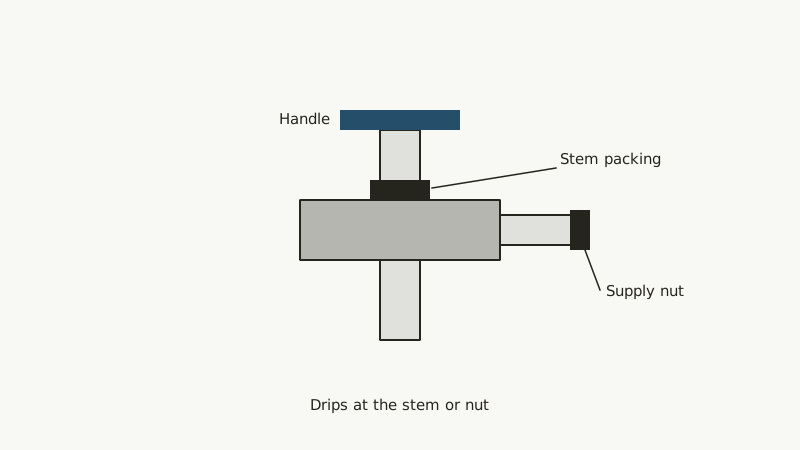
Age and disuse. One that has sat untouched for two decades gets a crust of minerals, and its rubber washer stiffens. Leaks usually come from the stem packing, where the handle shaft passes through the body, or around the nut that holds the supply line. A valve can also drip from the outlet because the seal no longer closes fully.
Hard water speeds the problem. Long Beach Utilities' 2025 report lists one zone averaging about 12.8 grains per gallon, which leaves scale on valve seats and stems. In older bungalows around Belmont Shore and Bixby Knolls, valves may date from a remodel decades ago and sit on galvanized or old copper stubs that do not like being disturbed. Dampness at the wall is often the first sign, followed by a rust stain on the floor.
The handle is stuck, or the valve will not seal: what are my options?
Resist the urge to force it, because a seized stem can snap and leave water running with nothing to stop it. Work the handle back and forth in small arcs to break up scale. If it moves yet still weeps when shut, or refuses to budge, turn off the house main and schedule a replacement.
The house main tends to sit out front by the meter or beside the water heater. Locate it before starting any toilet job. If a valve breaks and water is spraying, shut the main immediately; our page on burst pipe emergencies lists the other first steps. A valve that drips only when open may need nothing more than the packing nut snugged a quarter turn, a small adjustment you can try before replacing it.
How is a toilet stop valve replaced?
Begin by closing the house main, then flush to drain the tank. Take the supply line off, undo the large nut clamping the valve to the pipe, and pull the old body free. A fresh nut and ferrule go onto the pipe, followed by the new valve, which you snug down before reattaching the line. Turn the main back on gradually and watch each joint for drips.
Compression valves suit a do-it-yourselfer, since no torch is involved, though the pipe end has to be clean and round and a corroded stub may never seal. If the stub is galvanized or cracked, the repair becomes a pipe job. Soldered valves, or valves on a stub that must be cut shorter, are better left to a plumber because a poor joint behind a wall fails quietly. Mis-seated ferrules are the usual cause of slow leaks after a DIY swap.
Have a bucket and towels nearby, and snap a picture of the old arrangement first. After the new valve is on, give it a day and look again for dampness before you call it done.
Should the supply line be replaced at the same time?
Yes, if it is old. The braided or plastic line that links the valve to the tank has a limited life, and a stiff or discolored one is a failure waiting to happen. Replacing it during a valve swap costs little extra, and the guide we used puts the addition at about $20 to $60.
Inspect the tank-side connection as well. The fitting that screws into the fill valve wants hand pressure plus a small extra turn, never brute force. A weeping connection is often just a worn rubber washer inside the nut. If water appears on the floor, see whether it is the valve, the line or the tank before you replace parts. The toilet leak guide lays out how to trace it.
What does a pro charge for a valve swap?
One 2026 cost guide lists $150 to $400 per valve including labor and basic parts, with a typical total of $175 to $350. By scenario, a plain compression swap is about $125 to $250, a quarter-turn upgrade about $175 to $350, and soldered or cramped work $350 to $600. On simple jobs the service-call minimum of $125 to $250 often decides the bill.
Corroded pipe that needs a section replaced adds $75 to $200, and evening or weekend calls cost extra. Bundling brings it down, so have the other fixture valves done in the same visit. All of this is national data, not a Long Beach quote. When the toilet needs more than a valve, read toilet flush repair before booking. A compression valve alone costs $10 to $35.
Does swapping the valve need a permit in Long Beach?
The city asks for a plumbing permit when fixtures are installed, altered or replaced, and exempts leak stops, minor repairs that use no new materials, and a few named items such as swapping a defective toilet ballcock for an anti-siphon type. A stop valve is not among them, so ask before you start.
Building and Safety answers at 562-570-7648. Whoever does the work should know how the city treats it and pull a permit when one applies. Homeowners who live in a one- or two-family house can pull their own permit under the city's conditions. In San Pedro and Wilmington, the Los Angeles building department sets the rules instead.
Common questions
How frequently should I work the toilet stop?
Closing and reopening it yearly stops scale from locking it and warns you if it is failing. Go gently with a towel underneath. Replace any valve that will not shut fully or begins to weep, ideally before the day you actually need it.
Is a dripping stop valve urgent?
Usually not an emergency, though it should not wait long. A slow drip wastes water and can rot the wall or the flooring beneath it. Should water be spraying, or the handle no longer close anything, shut off the main and get help right away.
Can the valve be changed with the main left on?
Not safely. The valve is the very thing that isolates the toilet, so once it is off, the pipe is open to supply pressure. Close the main, or some upstream valve, first. If the main itself will not close, that is a bigger repair than this one.
Where do I ask for help with it?
Describe what you see on the quote page: where it drips, if the handle turns, how old the house is. We read requests on weekdays between nine and five, and any price is given in writing following a visit. Everything else we arrange appears on the Harbor Lights home page.
References
Updated