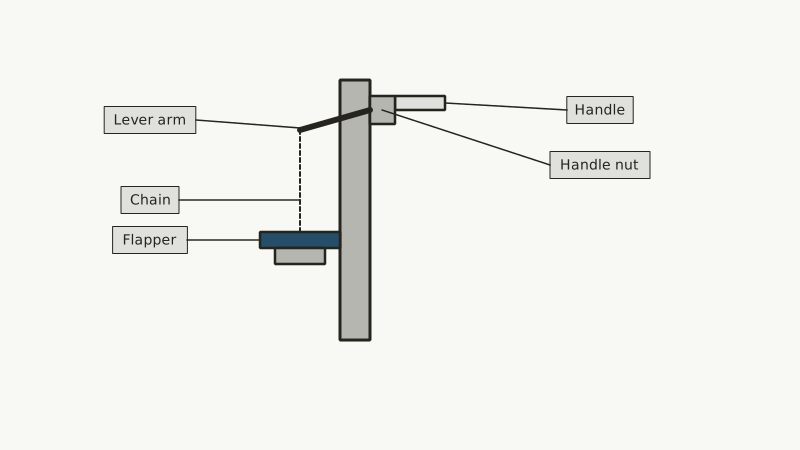
A handle that spins freely and does not flush has lost its grip on the chain. Lift the tank lid and trace the path: handle, lever arm, chain, flapper. Either the nut gripping the handle has backed off, the chain has dropped off the arm or snapped, or the lever itself has cracked. All three are quick repairs, and a replacement seldom runs past a few dollars. Related faults sit in our toilet repair guide, and flush strength is covered in a weak flush.
Why would the handle be loose and the flush dead?
The handle turns a metal arm inside the tank, and that arm pulls a chain that lifts the flapper. If the nut has backed off, the handle spins and the arm stays put. If the chain has slipped off or snapped, the arm moves but nothing lifts. If the lever is cracked or corroded, it turns without engaging.
Use what you see to narrow it. A handle that wobbles but still clicks the arm, only weakly, points to a loose nut. A handle that feels normal but does nothing points to the chain. A handle that flops down and stays there has a broken lever or a stuck flapper. In older houses, a lever that has sat in a damp tank for decades can corrode until the arm snaps, so age alone makes it a prime suspect. Lift the lid straight up and set it on a towel on the floor, since porcelain chips easily.
What do I look for inside the tank?
Check three things in order: whether the handle nut is snug, whether the chain is still hooked to the lever arm, and whether the arm itself is intact. Press the handle and watch the arm. It should rise, tug the chain and lift the flapper, then fall back when released.
Look at the chain too. It should hang with only a little slack when the flapper is shut; Korky says one or two extra links, while other makers suggest about half an inch. A chain that is too loose never lifts the flapper far enough, which gives a weak or failed flush, and one that is too tight keeps the flapper from sealing, so the toilet runs. Also check that the arm does not bump against the fill valve or the lid. A bent arm, or one rubbing against its neighbors, makes the handle feel stiff or stuck.
How do I tighten a loose handle?
Steady the handle with one hand and turn the locknut inside the tank with the other. Most lever nuts are reverse-threaded, so they tighten the opposite way from a normal nut, typically counterclockwise as you look at it from inside. Snug is enough; plastic threads strip if forced, and the manufacturer says to check your model.
Korky says most lever nuts are reverse-threaded, though its own steps are not consistent about direction, so make a small turn first and see whether the nut loosens or bites. Never use more than hand pressure plus a gentle nudge from pliers. Flush a few times to see if the handle now holds. If the nut will not stay tight or the threads are chewed, the whole lever should be replaced rather than patched.
How do I fix a chain that came off or broke?
Re-hook the chain on the lever arm, choosing the hole that leaves one or two spare links when the flapper is shut. A broken chain should be replaced, new or from a repair kit, rather than knotted, since knots catch on the flapper. If the clip is lost, a bent paper clip is only a temporary fix.
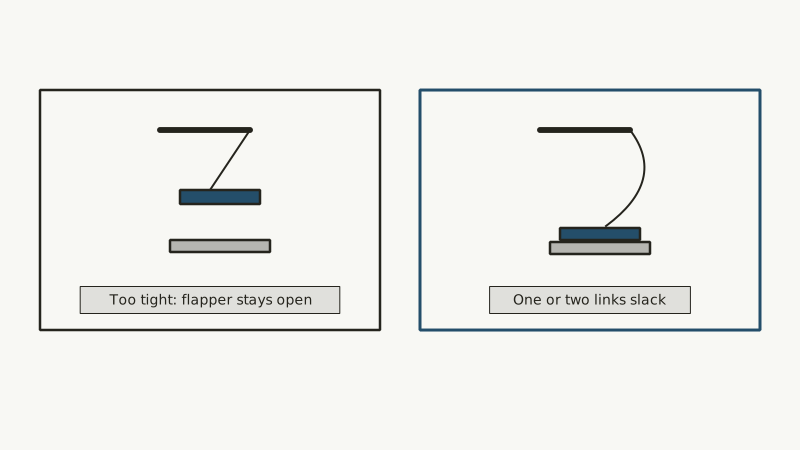
Trim extra chain so a loop cannot fall under the flapper and hold it open. Test by flushing and watching the flapper rise and fall completely. A slightly tight chain is as bad as a loose one: when the toilet keeps running afterward, the flapper is not sealing, which is the topic of toilet flapper repair and why a toilet keeps running. Fluidmaster's test for a leaking flapper is to mark the tank water level, shut off the supply and wait 10 to 15 minutes.
When does the lever deserve replacing?
Swap it out if the arm is cracked or corroded, if the handle will not stay tight, or if it fails to spring back. A standard lever is inexpensive: Thumbtack's October 2026 guide lists a standard toilet handle under $20 and a high-end trip lever at $50 to $100, with most parts such as the flapper and fill valve at $5 to $20.
Pick one that fits your tank. Levers mount at the front, the side or the corner, and the arm length matters, so compare the old one before buying. Korky advises setting the elbow near 30 degrees, pointing the arm toward the tank's front edge and keeping it clear of everything else. After installing, put the lid on and flush to confirm the bowl clears and the lever does not hit the lid. If the arm is too close to the fill valve, adjust the position. A new lever and chain together fix most handle faults.
What if the handle works but the flush is still weak?
Then the handle is not the culprit. A weak flush has other sources: excess chain slack, a flapper that drops early or leaks, low water in the tank, or a half-blocked bowl or drain. Work through the chain first, then the water level, then the flapper.
Blockages are the other usual reason. When the bowl fills and empties slowly, start with a plunger; the price of dealing with a stubborn one is in unclogging a toilet, costs. If several drains crawl together, the main line is suspect, and that needs a plumber. Standing water that does not move needs professional help. To book a visit, use the quote page; the figure is agreed in writing first. Thumbtack's October 2026 guide puts a simple toilet repair at about $100 to $250 nationally. Other services we arrange appear on the Harbor Lights home page.
Common questions
The handle turns freely and nothing happens. Why?
The locknut in the tank has backed off, or the lever is stripped or broken, so the handle no longer drives the arm. Lift the lid and look. Tighten a loose reverse-threaded nut by hand; if the threads are chewed or the arm has cracked, fit a new lever.
How do I flush it in the meantime?
Temporarily, lift the lid and raise the chain by hand, or tip a pail of water into the bowl so it flushes by gravity. Do not make a habit of it. A handle repair takes minutes, and an unrepaired lever can leave the flapper hanging and the tank running.
What is the right chain length?
Short enough to lift the flapper fully when you press the handle, but with a little slack when the flapper is closed. Korky says one or two extra links, and other manufacturers suggest about half an inch. Too tight keeps the flapper from sealing, and too loose gives a weak flush.
Is a plumber needed to swap a handle?
Generally no. A lever swap needs no special tools and no water shutoff, though closing the supply is smart if you will touch the flapper or fill valve too. Hire a plumber for a cracked tank, parts corroded solid, or water around the base.
References
Updated