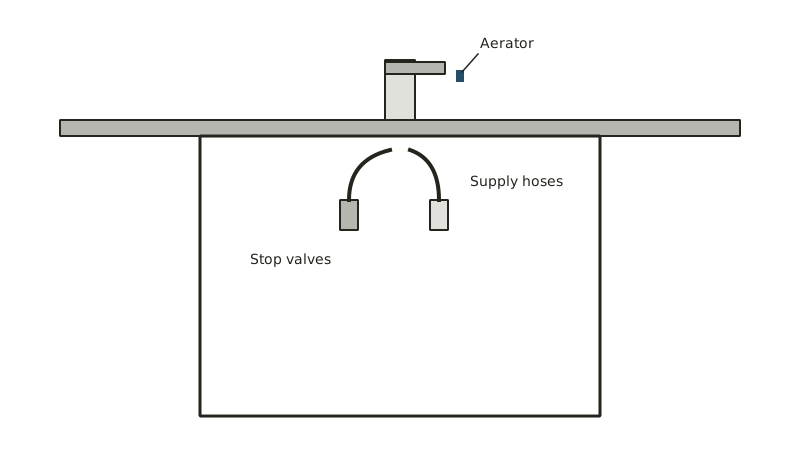
A feeble stream hurts most at the kitchen sink, where pots get filled and dishes rinsed all day. One question sorts out much of it: is the trouble this faucet alone, one temperature, or the entire house? The cabinet below also holds the dishwasher and disposal, topics covered on the kitchen sink and disposal page.
Where does the weakness show up besides this sink?
Try the bathroom tap and the shower. Strong flow there confines the trouble to this faucet or its two feed lines. Weak everywhere moves the cause upstream, to a main shutoff opened only partway, a regulator wearing out, or a restriction in the service line, which the guide to low pressure throughout the house covers.
Then separate the temperatures by running cold alone and then hot alone. Feebleness on one side implicates that side's shutoff, its supply hose or, for hot, the heater. Feebleness on both, while every other fixture is normal, implicates the faucet body, aerator or spray hose.
Notice too whether flow drops when a neighbor fixture starts, such as a shower or the washer. That behavior suggests a restricted supply line, a pattern described under sudden pressure drops. And ask what changed on the day it began: plumbing work, a neighborhood shutoff, or a repair beneath the sink.
Is a plugged aerator the usual suspect?
Most often, yes. That little screen at the spout tip blends air into the stream, and mineral flakes and pipe debris collect in it until the opening shrinks. Twist it off, rinse the mesh, leave it in vinegar about sixty minutes when crusty, then thread it back.
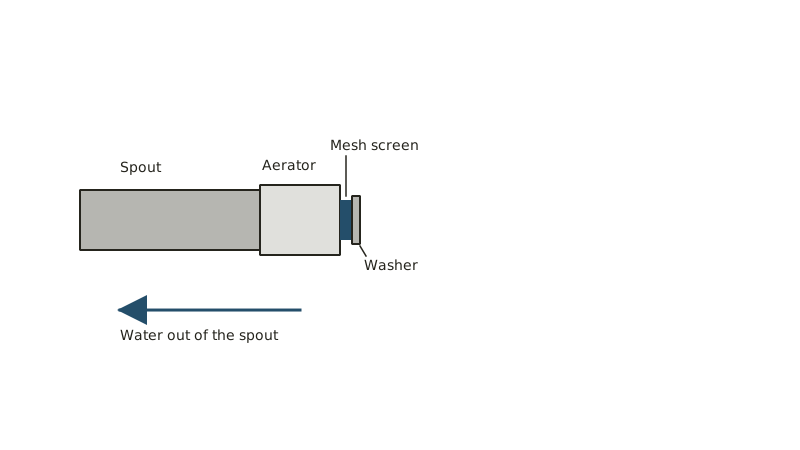
Wrap the spout in a rag or tape to spare the finish. On pull-down faucets the aerator lives in the spray head, and it unscrews in the same way. Run the tap briefly with the aerator out; strong flow proves the screen was to blame, and a replacement is cheap.
Design matters as well. The Department of Energy's Building America material lists kitchen sinks at about one to two and a half gallons a minute, so a newer low-flow aerator can feel anemic next to the one it replaced. According to EPA, a labeled water-saving aerator may cut sink flow by about a third or more compared with the older 2.2 gallon standard.
Shopping for a replacement faucet? The page on faucet installation describes what a visit involves.
Could the stop valves or hoses under the sink be pinching the flow?
Check the pair of small valves in the cabinet. One bumped while cleaning, or never opened fully, throttles that side. Turn each handle all the way counterclockwise. Follow the flexible hoses next: a sharp kink behind the cabinet, or a hose squashed by stored bottles, pinches the stream.
Old braided or rubber hoses can fail internally, the liner collapsing or filling with grit while the outside looks fine. With valves fully open and hoses straight but flow still poor, close the valve, detach the hose over a bucket, and crack the valve open. Strong flow there points to the hose, a cheap part to replace.
Grit appears after construction or a water main repair nearby, when stirred-up grit lodges in aerators and valve screens. If the problem began right after one, clear the lines by letting the tap run with the aerator off.
Might the sprayer diverter or the cartridge be at fault?
Yes. Faucets with a pull-out head contain a diverter that routes water to the spout or the spray, and a worn or gritty one weakens both. A pinched or leaking spray hose underneath does the same. The cartridge, the cylinder inside a single-handle body, can also wear out or fill with scale.
A failing cartridge shows up as a gritty-feeling handle, flow that shifts with handle position, a drip at the spout, or hot and cold that stop blending evenly. Swapping one is routine; the repair guides for a dripping sink faucet and a two-handle model show the parts.
Test the spray separately by pulling the hose clear of the cabinet and watching the head at its connection. A strong spout with a weak spray, or the opposite, points to the part to open up.
Does local hard water leave scale inside the faucet?
Probably. Calcium and magnesium deposits collect in aerators, cartridges and older pipe, narrowing the passages year by year. Long Beach Utilities' 2025 report shows average hardness near 12.8 grains per gallon where imported water is delivered and about 4.4 in the blended zone.
Your street decides which figure applies, and San Pedro and Wilmington buy from LADWP instead. An aerator that turns chalky every few months tells you the water carries minerals; ideas for dealing with it are in removing hard water scale.
Vinegar soaks revive aerators and showerheads. When cleaning does not restore a faucet body, the cartridge, or the entire faucet, may be spent, and replacement is often tidier, particularly on one that has served ten to fifteen years.
What signals that this is more than a faucet problem?
More fixtures affected, a sudden drop, banging pipes or wet spots. A failed regulator, a main valve left partly shut, a leak in the line, or corrosion in old galvanized pipe can each lower pressure everywhere. Leaks raise the stakes: EPA reports yearly household losses of more than 9,300 gallons.
Weakness only on the hot side may trace to sediment in the heater or its outlet, discussed in low hot water pressure. For a house-wide reading, fit a pressure gauge to an exterior hose spigot. Next steps are on why water pressure drops and regulator replacement.
In Long Beach, replacing piping or a regulator brings permit questions, because new materials fall outside the exemption for minor repairs. Requests for a visit, with the price written down, go through the quote form.
Common questions
What leaves one sink weak while everything else runs normally?
Typically a clogged aerator, diverter or cartridge in that faucet, or a stop valve beneath it that is partly shut. The other fixtures have separate parts, which is why they run normally. Clean the aerator first, then inspect both valves and both hoses, and look at the spray head if yours pulls out.
Does vinegar really dissolve aerator buildup?
For mineral scale, yes. Take the aerator off, let it stand in white vinegar for about sixty minutes, brush it softly, rinse, and refit it. Keep delicate faucet finishes out of the bath. A torn screen, or flow that stays poor, means a new aerator.
Hot feeble, cold strong: where do I look?
On the hot path: its stop valve, its hose, a clogged cartridge port, or the heater. Sediment or a faulty valve at the heater outlet can choke flow. Other hot taps in the house weak too? Inspect the heater first.
At what stage should I bring in a professional?
When a clean aerator and fully open valves change nothing, when hoses or a cartridge need swapping and you would rather not do it yourself, or when several fixtures are running low. Tell whoever visits which temperature is weak and the date it started.
The rest of our guides start from Long Beach plumber.
References
- U.S. EPA WaterSense, bathroom sink faucets (flow rates and aerators)
- U.S. Department of Energy, Building America, tankless water heaters (typical end-use flow rates)
- Long Beach Utilities, 2025 Annual Water Quality Report
- City of Long Beach, plumbing permit requirements
- U.S. EPA WaterSense, Fix a Leak Week
Updated