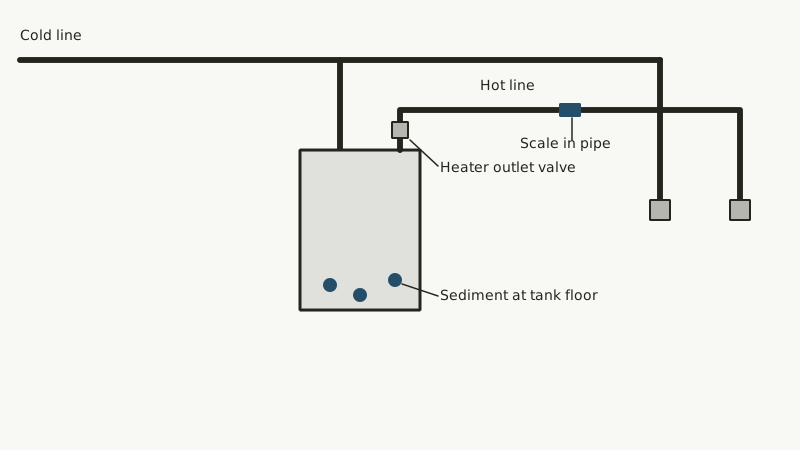
Cold water blasts out; hot dribbles. That mismatch is useful, because it tells you the street supply is fine and the fault lies somewhere along the hot route: the heater, its two shutoffs, or the pipe and fixture on the way. Below, the suspects run in the order a plumber would test them. For what a service call involves, see water heater repair; to request one, use the quote form.
Why is the hot side weak when the cold side is strong?
Because hot and cold split at the heater and travel in separate pipes. Cold reaches the tap directly. Hot has to pass through the tank, its valves and its own run of piping first. Anything narrowing that second journey, such as a half-open valve, scale inside pipe, or sediment at the outlet, weakens only the hot flow.
Start with a map of the damage. Open hot at the kitchen sink, a bathroom and the tub. Three weak outlets implicate the tank or the main hot trunk line. One weak outlet implicates that fixture or the short pipe feeding it, which clears the heater.
Which parts of the heater deserve a look before anything else?
Two valves sit above the tank: cold in, hot out. Each should be wide open, meaning, on a ball valve, a lever parallel to the pipe. One bumped shut during earlier service is the cheapest explanation there is, and eliminating it takes seconds. Also confirm that nothing leaks at the connectors.
If you have a gas unit, a pilot or burner problem would cause a lack of heat, not weak flow, so keep the two symptoms apart. Be careful: do not open or tamper with the gas valve or flue. Leave anything involving the burner, the relief valve discharge pipe or gas connections to a contractor. Replacing the tank outright is a permit job in Long Beach.
Could sediment or scale in the tank or pipes cut the flow?
Yes, and in Long Beach this is the leading local suspect. Heating water drops its minerals out, so a tank collects sediment on the bottom and pipe walls collect a crust over time. The utility's 2025 report lists average hardness near 220 ppm in one zone and 76 ppm in another, reaching 300 ppm at the top of the harder zone's range.
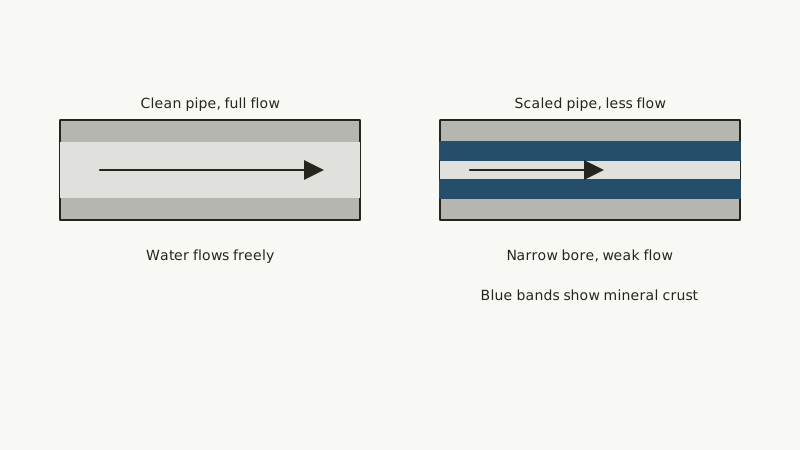
The maker A. O. Smith says to drain and flush a tank as annual maintenance, draining a few gallons and, if the water runs milky, the whole tank, and to check the anode rod at least every three years, yearly if a softener is installed. Chunks of broken lime can also clog aerators and cartridge screens. When the unit is elderly and drained water carries grit, its scale problem may have reached the outlet pipe.
Is old pipe the real problem?
Often it is when the weakness spreads through the house on the hot side only. Galvanized steel narrows from the inside as rust and scale build up, and hot lines tend to suffer more, since heat speeds up mineral deposits. Homes in Belmont Shore and Bixby Knolls from before about 1960 are where that is most plausible.
A plumber can confirm by cutting a section out and looking inside, or by comparing flow where hot leaves the tank against the farthest tap. The remedy is new pipe for the affected run, occasionally the entire house, a project of its own described under galvanized pipe replacement. A permit applies, and the contractor must be on the state's license rolls.
What about a single faucet, shower or appliance that is weak on hot only?
Look at that fixture's own parts. Scale in a showerhead or aerator, a cartridge gummed with debris in a one-lever mixer, a hot-side stop valve under the sink not fully open, or a kinked braided hose can all limit one outlet. A washing machine's hot inlet screen is another place where grit collects.
Unscrew the aerator and rinse it. With both stop valves closed under the sink, you can detach the hot hose and clean its screen. Shower owners get the steps in our shower pressure guide. If one faucet is the only weak spot after all that, the cartridge or the valve body may need replacing.
Does a tankless heater behave differently?
A tankless unit limits how much hot water can pass per minute, meaning a pair of showers plus a dishwasher on together will each get less, even though nothing is broken. Mineral crust inside the exchanger narrows the path as well, and inlet screens on many models clog.
Check the manual for a descaling procedure and ask a plumber about flushing it with a descaling solution. If low flow showed up right after installation, the gas line or water line sizing may be the cause. For the unit's repair issues, read about tankless gas water heater repair.
Does the heater need replacing rather than more troubleshooting?
When the tank is well past the middle of its life, leaks, or is choked with scale you cannot flush out. A heater is a poor place to throw repair money if sediment has damaged the tank and the anode is gone. A plumber can weigh repair against replacement for you. Long Beach requires a permit for replacement, plus strapping and a relief valve.
Remember pressure itself. Most experts, per A. O. Smith's guide, set the pressure reducing valve at 50 to 60 psi, and a dripping relief valve often means pressure is too high. Weak hot flow that comes with a dripping relief valve suggests a regulator or expansion tank issue instead. Our pages on replacing an expansion tank and water heater replacement cost cover both.
If the hot side is weak only at the washer, the washing machine with no hot water guide covers the hose and valve checks.
Common questions
How long does hot water pressure repair take?
A valve turn or an aerator rinse costs minutes. Flushing the tank runs about an hour with draining and refilling. New pipe sections, a mixing valve or a whole heater can eat a day or more, and a first look tells the plumber which bracket you are in.
What belongs on my list of questions for the visit?
Have the plumber measure flow where hot leaves the tank and at the weak tap, describe the finding in plain words, and a written price comes before the work, along with the license number and an answer on permits. Guesswork without measurements is a gamble with your cash.
Can I flush the tank myself?
Many homeowners do, following the maker's manual: switch off power or gas, close the cold feed, then connect a hose to the tank's drain and aim it at a floor drain, and open one hot tap upstairs. Hot water scalds, so keep clear of the hose end. A brittle plastic drain valve or one that will not budge means stopping and phoning a plumber.
This guide is one of many on Long Beach plumber.
References
Updated