Slow fading across a year smells like scale in old pipe. A drop you noticed this morning smells like a change: a valve nudged, a regulator giving out, a break somewhere or crews working on the street. Our low water pressure hub gives the broad picture, and this page is a quick triage for the abrupt case.
Do all the taps feel weak, or only one?
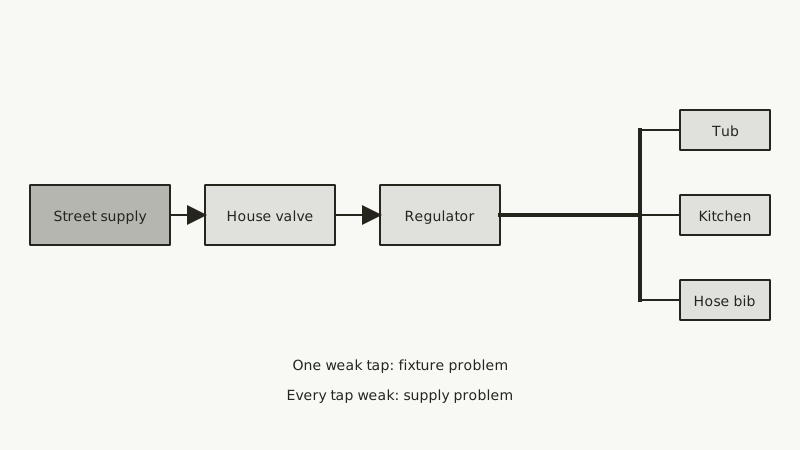
Compare three outlets: a tub spout, an outdoor hose bib and a kitchen faucet. Weakness at one outlet alone points at that fixture, usually a plugged aerator, showerhead or half-open stop. Weakness everywhere sends you looking farther back, as far back as the street supply, with the house valve, the regulator and a hidden leak as stops along the way.
Weakness limited to hot water is a heater matter, described under weak hot water flow. A weak shower alone has its own page on shower pressure, and so does the kitchen faucet.
Cleaning an aerator costs nothing: twist it off, rinse the mesh and soak mineral crust in white vinegar. That test only matters for single-fixture trouble.
Is something going on at the curb or down the block?
Rule this out first since it is free. Ask the house next door, watch for utility trucks, cones or door hangers. Work on a main can lower pressure, shake loose sediment and trap air in house lines. Long Beach Utilities supplies most of the city, whereas San Pedro and Wilmington are served by LADWP, so contact the right agency if you suspect the supply.
After street work, open a cold tap in the tub for several minutes to push out air and silt, then clean the aerators because grit collects there. If pressure bounces back within hours, the street was the cause.
Neighbors fine and you not? Then the fault belongs to your plumbing, and the checks below apply.
Was the main valve bumped or left half closed?
Plumbing visits, meter work and curious kids all leave main valves partly shut. A gate valve closed even a quarter of the way chokes the whole house. Find it where the line enters or at the meter box. A wheel opens by turning counterclockwise, while a lever is open when it runs in the same direction as the pipe.
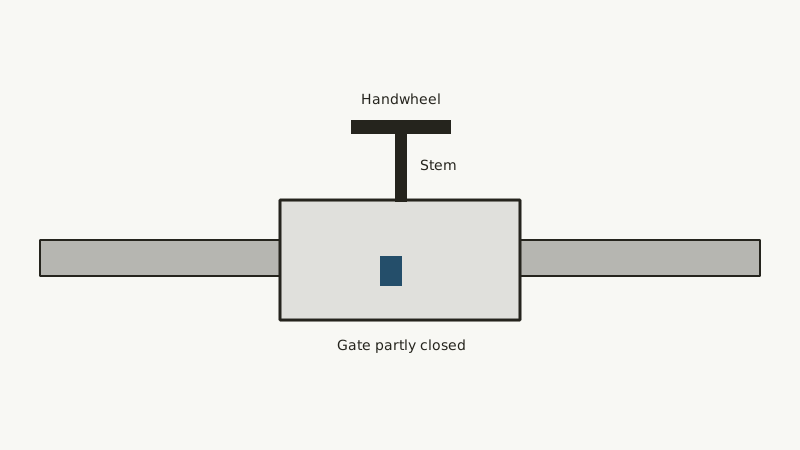
Most houses have two valves in sequence: the utility's at the meter and the owner's at the house. Leave the utility's alone. A house valve that is stiff, weeps around the stem or refuses to move needs replacing, and that is the right time to have the regulator looked at too.
Look at the stops at the water heater and beneath the sinks too. One partly closed there starves only a fixture or only the hot side.
Has the pressure regulator quit?
A failed regulator can bring pressure down or let it spike, and abrupt change is typical of one. Spin a gauge onto an exterior spigot to get a number. Household pressure is often quoted around 40 to 60 psi, with California expecting a regulator wherever street pressure exceeds 80 psi.
A number well below your old normal, while the meter spins freely, implicates the valve. Our walkthroughs on setting the valve and on replacing it explain next steps, and published cost guides show a few hundred dollars installed.
Some older Long Beach houses never had one, so street pressure arrives unfiltered and a sudden drop more likely lies upstream.
Is water escaping somewhere it should not be?
It could be. A cracked line between meter and house, a failed fitting in a wall or a slab leak all bleed pressure and push up the bill. Shut every tap, copy the meter reading, wait two hours and compare. The EPA says a moving number probably means a leak.
Other signs: a meter dial turning with nothing running, a soggy patch in the yard, a warm floor, hissing inside a wall or damp drywall. Early detection tips are in our page on stopping burst pipes before they happen. If you see water escaping, close the house valve and call a plumber, since acoustic gear and cameras can pinpoint the leak without demolition.
Galvanized pipe adds another possibility. Wikipedia describes it as rusting from the inside out, and a loosened flake can plug a line suddenly. Bungalows of the twenties through fifties are the likeliest candidates.
What tips the decision toward calling a pro?
Call when the main is fully open, neighbors are fine, the meter creeps with everything off, the gauge is low or the house is old enough for galvanized steel. Harbor Lights arranges for a local plumber to test the valve, gauge and meter, with a written quote delivered before work begins. More causes sit on the pressure checklist.
Swapping a main shutoff, regulator or stretch of pipe is regulated work. Long Beach wants a plumbing permit for alterations, a California contractor license applies, and only a few small jobs are exempt.
Common questions
What makes pressure fall overnight?
Four suspects cover most cases: street main work, a valve left only partly open, a regulator that gave out and a leak. Ask next door, inspect the main, monitor the meter while nothing runs and read a gauge. Together those tests identify the cause in the large majority of houses.
Will weak pressure harm the plumbing?
Weak flow seldom hurts pipes directly, but its cause may: leaks flood floors, and scale or a dying valve worsens with time. Washers and dishwashers can fail to fill properly. Excess pressure is what strains plumbing, which is why the gauge matters in both directions.
Does the heater change the pressure at my taps?
On the hot side, yes. A valve left partly shut at the heater, a clogged inlet screen or a layer of sediment can choke hot flow while cold stays normal. When both lines are weak, the culprit sits upstream of the tank. Flushing the tank and working the valves is routine for a plumber.
What does fixing this usually cost?
Nothing if the answer is a valve you simply open, a few hundred for a new regulator and more for pipe repairs. Published guides place regulator replacement between roughly $200 and $700. Treat that as a loose benchmark. The number that matters comes in the written quote after a visit.
The rest of our guides start from Harbor Lights Plumbing.
References
Updated