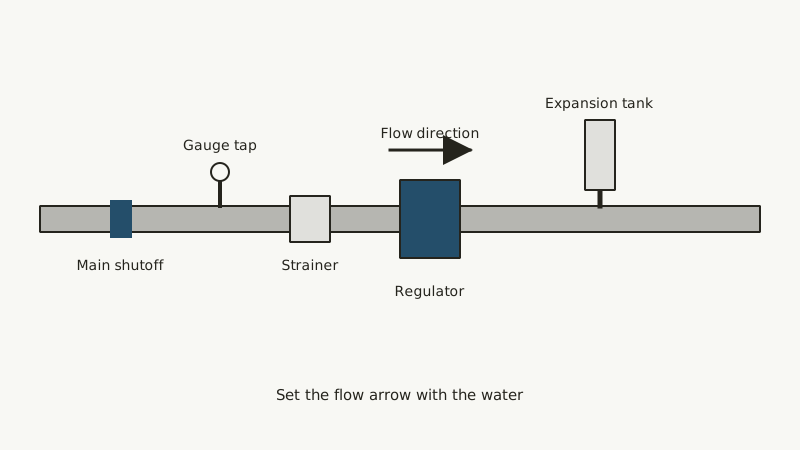
A dead regulator does one of two things: it lets main-line pressure rush through the house, or it strangles the supply. Swapping in a valve of matching size and dialing in a reasonable setting is the remedy, and in many houses it fits in a morning. Unsure whether your weak flow even involves the regulator? Start with the broader page on low water pressure help, then return here with a gauge reading in hand.
How do I know the regulator, and not something else, needs replacing?
Thread a gauge onto the garden spigot and read the needle. Anything stuck above roughly 75 psi, parked very low, or jumping about 10 psi between checks implicates a valve that cannot hold a steady number. Other hints are banging pipes, a weeping relief valve on the heater, dripping taps and a toilet that runs.
Plumbing firms often describe 40 to 60 psi as a comfortable household band, and the state plumbing code makes a regulator mandatory the moment static pressure passes 80 psi, with the result held at 80 or less. Regulator life estimates span roughly 5 to 20 years, most between 10 and 15. Age does not prove failure; only the gauge does. A heater valve that drips is frequently the first clue, and the article on relief valve replacement explains why pressure is the usual cause.
What does a new regulator have to match?
Start with pipe size and end type. Three-quarter or one-inch supply lines are typical, ending in threads, unions or solder, and the new body should slot in without reworking the pipe. Code language calls for an approved regulator, strainer upstream, meeting ASSE 1003 or AWWA C530.
Look at the adjustment range too, because residential regulators work within a band and the model must reach the setting you want. Unions on both sides let a valve drop in; one soldered into copper means cutting the pipe and soldering again. If the old unit has a bypass or a strainer screen, keep that arrangement. Where the regulator sits is covered in where to find the regulator, since it may be at the main, in a garage wall or in a crawl space.
What are the steps of a replacement?
Read the pressure, shut the main, and crack a tap to bleed the lines down. The old valve comes out at its unions or gets cut free, the new one goes in with its flow arrow aimed the right way, and the main is reopened slowly while a tap lets air escape. A gauge on the spigot guides the final setting, and the joints get a second look the next day.
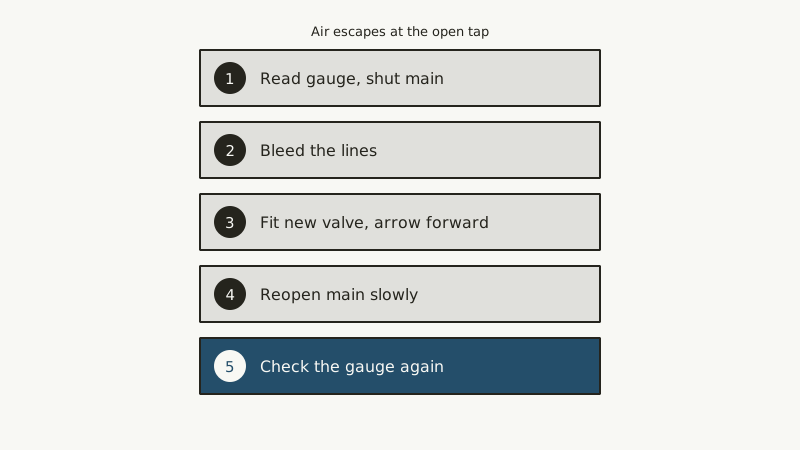
One detail matters most: the arrow cast into the body must point downstream, toward the house. Once the water is back, run a hot tap to purge air and inspect every joint. The adjusting screw on top of the bell raises pressure when turned clockwise and lowers it counterclockwise, so go in small steps with the gauge watched each time. Write the final number down. How the adjustment works is shown in the regulator adjustment guide.
Does a new regulator mean I also need an expansion tank?
Often. A regulator closes the system, so heated water cannot back out and pressure can spike inside the house. Under the state code, an approved expansion tank sits on the cold supply downstream of the regulator, though an engineered system, drawn up by a plumbing contractor or design professional, may use a relief valve set at no more than 100 psi instead.
A dripping heater valve can mean the tank is missing, since published guides name thermal expansion in a sealed system as one cause. A tank already on the pipe deserves a check of its air charge and condition, because a dead one acts like no tank. When the tank is the absent or failing piece, see expansion tank replacement.
Is this a DIY job, and does Long Beach want a permit?
A handy owner can manage a union-fitted swap, though the stakes are real: a fully closed main, correct orientation and a checked setting. In Long Beach, plumbing work generally calls for a permit, exempting repairs that use no new materials, and a regulator is a new part, so ask Building and Safety.
An owner-occupant of a one- or two-family house may pull the permit for personal work, subject to the city's conditions, which include a signed statement that no workers will be hired. Work must be inspected before it is concealed. San Pedro and Wilmington answer to the Los Angeles building department. Soldering, or a main shutoff that leaks or will not close, is a reason to hire it out rather than risk a flooded house.
Which figures should I expect to see on a quote?
Angi's 2026 figures show roughly $200 to $700 nationally for a replacement, averaging near $400. Hardware is the smaller piece; labor and reach make up the rest. A regulator on an open garage wall goes quickly, while one buried behind stucco or in a cramped crawl space eats hours.
Extras include soldered connections, an added expansion tank, a missing strainer, brittle galvanized pipe that resists cutting, and permit fees. Older bungalows around Belmont Shore and Bixby Knolls are more likely to hide such pipe. Hard water adds scale on moving parts too, with one Long Beach Utilities zone averaging about 12.8 grains per gallon, and a strainer screen can clog. The regulator cost page itemizes the figures. Read all of these as rough guides, because only the written quote binds.
What should a plumber check after the swap?
The spigot gauge, both with water running and with everything shut; every joint for weeps; the heater's relief valve plus any expansion tank; and the flow at the farthest fixture. A careful plumber also names the final setting and shows you where the valve lives, so a cheap gauge can check it each year.
Get the setting in writing, so that if pressure creeps up later or the heater valve starts dripping, you have a number to compare against. A visit starts on our quote page. Our other trades are on the Harbor Lights home page.
Common questions
Is this a morning job or an all-day one?
Expect one to three hours, per published guides, for a straight swap on unions, covering shutoff, installation, bleeding air and setting pressure. Soldering, extra pipe or an expansion tank lengthens it. With water off for most of the visit, fill a few containers beforehand.
What pressure should it be set to?
Plenty of plumbers target 50 to 60 psi, while the state limit is 80 psi static. Lower is gentler on fixtures and the heater, but too low means thin showers. Set it with a gauge, then test a tap far from the main. A slightly higher number is acceptable when the house needs it, inside the code.
Will a new regulator fix low pressure?
Only when the old one was at fault. A failed regulator can choke flow, yet weak pressure also arises from clogged filters, half-open valves, rusted pipe or a street-side issue. Test before buying. A healthy gauge reading with thin showers sends you to the fixtures and lines instead.
Can the old valve be rebuilt instead of replaced?
Sometimes. Certain models take a repair cartridge or diaphragm kit that costs less than a new valve. Many plumbers swap the whole unit, because the labor is similar and an old body may be scaled or corroded. Ask which path the quote assumes, kit or new valve.
References
- California Plumbing Code 608.2, excessive water pressure
- Angi, cost to replace a water pressure regulator (2026 data, via search summary)
- City of Long Beach, plumbing permit requirements
- ReplacementGuide, T&P relief valve and causes of dripping (high pressure and thermal expansion)
- Long Beach Utilities, 2025 water quality report
- Published guides on regulator lifespan and failure signs from plumbing firms, read November 2026
Updated