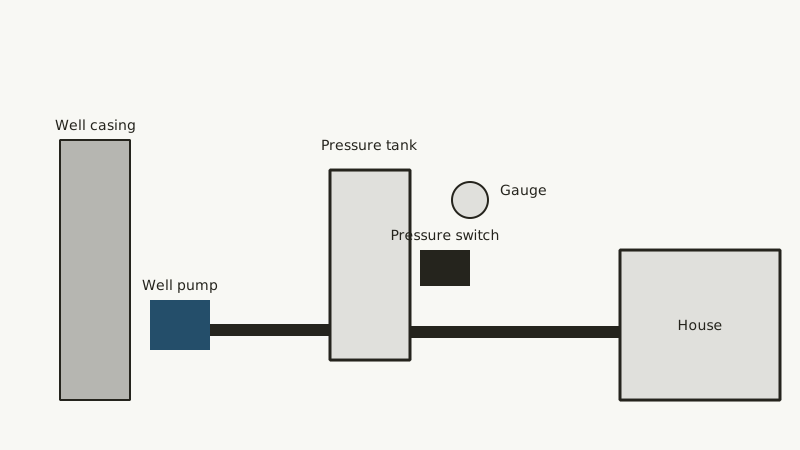
Check where your water comes from first. Within Long Beach, most homes take city water, and the "wells" behind that supply belong to the utility: its 2025 report says about 71 percent of the city's water is local groundwater. A pressure drop in that case is a low water pressure question about the main or your own plumbing. Only a private well has a pump and tank of your own, which is what this page covers.
Is my pressure problem a well problem or a city-water problem?
Water that reaches you through a utility meter with a monthly bill is city water. Then the suspects are the meter, the main valve, the pressure regulator and the taps. If a pump sits in a well or shed on your property with a pressure tank beside it, it is a private well, and the tank, switch and pump are your responsibility.
Not sure? Look for a pressure tank, a painted steel or blue cylinder near the pump, and a gauge showing roughly 40 to 60 psi. For city water, call Long Beach Utilities at (562) 570-2390 about a street-wide problem; San Pedro and Wilmington are served by LADWP. For a private well, nobody else maintains the system. The CDC notes that officials do not regulate, treat or monitor tap water from private wells.
What usually causes low pressure on a well, in order of likelihood?
A waterlogged pressure tank comes first, then a faulty pressure switch, then a failing pump, a falling water table, a clogged well screen, and clogged filters or treatment equipment. One well-service guide ranks them in that order, and the first three are the likely culprits. Work through the cheap checks before assuming the pump.
The tank holds a cushion of air so the pump does not run every time you open a tap. When its air bladder fails, the tank floods and the pump short-cycles, clicking on and off, with pressure that rises and collapses. A 40/60 switch turns the pump on at 40 psi and off at 60, so a gauge that never reaches 60, or swings widely, tells you where to look. Penn State Extension describes the same set-up: the switch stops the pump near its cut-out and restarts it as pressure falls.
How do I check the pressure tank and switch?
Turn off power to the pump at the breaker and open a tap to bleed the tank's pressure to zero. Press the tire-style air valve on top: if water sprays out, the bladder has failed and the tank needs replacing. If air comes out, check it with a tire gauge; the charge should sit 2 psi under the switch's cut-in, so 38 psi for a 40/60 system.
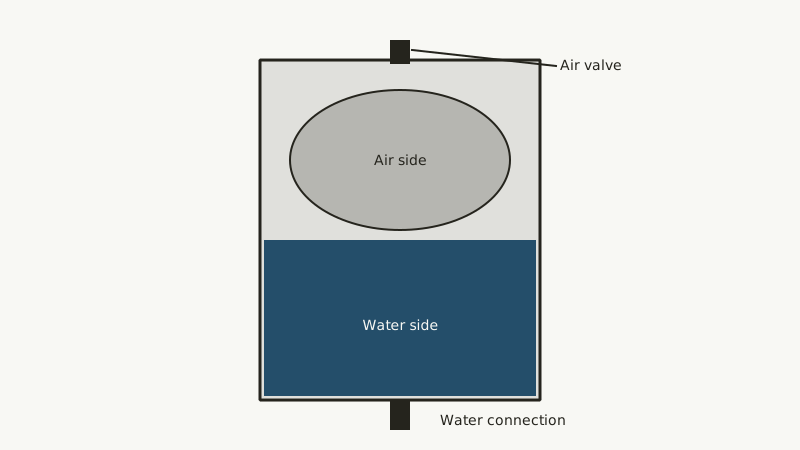
Then look at the switch with the power off: pitted contacts, a clogged sensing port or debris can keep the pump from starting or stopping. A bounce on the gauge needle and clicking pump point to the tank. A pump that will not start at all points to the breaker, the switch or the pump. Do not raise the cut-out above 60 psi to chase higher pressure, because that stresses pipes and the pump. A guide to this system puts a tank replacement at $300 to $700 installed and a switch at $75 to $200 with labor.
Pressure is fine outdoors but weak in the house. Why?
Indoor weakness paired with a healthy outdoor reading suggests a restriction on the way to the indoor taps. Candidates are a clogged filter or softener, a valve that is part open, a tired regulator, or scale-choked pipe. A hose bib may sit upstream of that restriction, so it looks normal while indoor taps fall short.
Test with the whole-house filter or softener on bypass, since a clogged cartridge is a common culprit; the guide we used prices a filter cartridge at $5 to $30. If pressure returns with the bypass open, the treatment equipment is the restriction. A regulator, which state code mandates above 80 psi static, can also throttle flow once worn; regulator replacement explains that job. One weak tap alone usually means a plugged aerator or showerhead.
Pressure collapsed all at once, or only when it turned cold. What then?
A sharp, sudden loss often traces to a tripped breaker, a failed switch, a ruptured bladder, a burst line or a pump that has quit. Check the breaker and the gauge before anything else. Cold weather is rarely the cause in Southern California, but exposed lines can freeze on a rare night. Dry spells can also lower the water table.
If the pump runs constantly and pressure stays low, shut the system off to protect the pump and look for a leak: water sprays in the yard, a wet spot, or a meter-less test where you close all taps and see whether the pressure gauge falls steadily. A failing well or a falling water level can show up as sputtering or air in the lines, especially at the end of a dry season. That calls for a well contractor, not a home fix. Our guide to fixing low pressure in a house covers general checks that apply either way.
Whose job is a low-pressure well: plumber, well specialist or utility?
The tank, switch and filters are plumber territory. The pump, the well casing, yield testing or lowering a pump belong to a well contractor, and the state license board's website shows which classification a contractor holds. A city-water problem starts with the utility, then a plumber if the neighbors are fine.
One visit often shows whether the trouble sits on the well side or the house side. We arrange plumbers for the house side; deep well and pump work usually belongs to a well specialist, and we would say so rather than guess. On city water instead? Begin with our page on sudden low pressure.
Should the well water be tested when I fix the system?
Yes, once a year, and after any repair to the well system. The CDC says to test at least annually for total coliform bacteria, nitrates, total dissolved solids and pH, and to test again if you repair or replace part of the well system or notice a change in taste, color or smell. Use a laboratory approved by the state.
Since private wells are not regulated or monitored by government, the owner is responsible. Low pressure from a failing well can come with cloudy or sandy water, and a test is the sensible follow-up. Take a sample after the system is repaired and flushed. Local health and environmental departments can point to approved labs.
Common questions
Would a booster pump or a higher setting solve it?
Sometimes, though it treats a symptom. If the tank and switch are healthy and the well produces enough water, a booster or a different switch setting can help. If the tank is waterlogged or the well is weak, it will not. Do not set cut-out above 60 psi, and keep the plumbing's 80 psi ceiling in mind.
How long does a pressure tank last?
University of Maryland Extension says a bladder tank lasts about 5 to 7 years on average, though some last longer. A tank of that age that short-cycles is the first suspect. Plenty of owners replace it themselves, and a plumber or a well specialist can also do it and set the precharge.
Is a clicking pump dangerous to leave alone?
It is hard on the equipment. Short cycling overheats the pump motor and wears the switch contacts, so a clicking pump that will not settle should be fixed soon. In the meantime, shut off power to the pump at the breaker if it will not stop cycling, and use stored water only as needed.
How do I ask someone to look at a well system?
Describe the gauge reading, any clicking from the pump and when it began on the quote page. Requests are read weekdays between 9 and 5. Our other trades appear on the Harbor Lights home page, and work on the pump itself may need a well specialist.
References
- The Well Guide, well water pressure low (well-service guide, read November 2026)
- Penn State Extension, Using Low-Yielding Wells
- University of Maryland Extension, Troubleshooting Bladder Pressure Tanks
- CDC, Guidelines for Testing Well Water
- Long Beach Utilities, 2025 water quality report (sources of city supply)
- Long Beach Utilities, water services and emergency contact
- California Plumbing Code 608.2, excessive water pressure
- California Contractors State License Board
Updated