Think of the bill as a meter reading with a price tag. More dollars means more gallons crossed the meter, so the real question is where they went. Usual answers: a toilet that never fully stops, a drip, sprinklers, houseguests, or a leak somewhere out of sight. Take the suspects in order from cheap to costly. The Harbor Lights home page shows what we line up when a plumbing fault turns out to be the cause, but you can narrow it down yourself first.
Which causes does the city itself list for a jump in the bill?
Long Beach Utilities publishes a short list: a running toilet, a dripping faucet, filling a pool or hot tub, watering lawns, new grass or trees, a broken or leaking pipe, a leaking water heater, more people at home, a water-cooled air conditioner, a misbehaving furnace humidifier, and a softener that regenerates nonstop. Leaving a tap on to protect pipes from freezing appears as well.
Plenty of those are habits, not defects. A school break with teenagers home, a relative staying for three weeks, or a freshly seeded lawn can double consumption without one drop escaping. Check the calendar for the billing period before opening walls. Households in San Pedro and Wilmington buy water from LADWP, which has its own bill and its own adjustment rules, though the detective work is identical.
Long Beach also offers a free WaterSmart portal with usage history and high-use alerts. A day-by-day view tells you whether water flowed steadily overnight, which suggests a leak, or in bursts through the day, which suggests ordinary use.
How can I tell whether water is flowing while nobody is home?
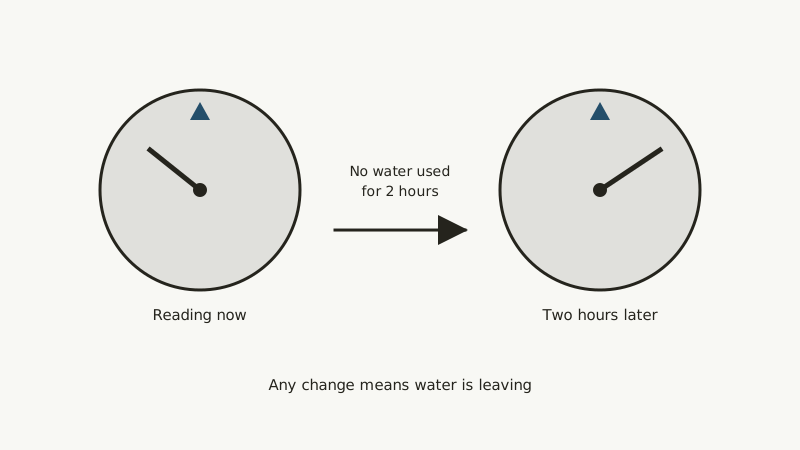
Jot down the meter reading, go two hours without drawing any water, then jot it down once more. First close every tap and pause the dishwasher and washing machine. Any movement in the dial or the little low-flow triangle means water is leaving the plumbing somewhere. Immediate movement hints at a fast leak, and a change that only appears after the wait hints at a slow one.
The utility and the EPA both suggest this pause, and it needs nothing but a pencil. If the numbers hold steady, the extra gallons were used, not lost, and the answer sits in routines. If they shift, continue down the list: toilets, outdoor connections, then the area around the water heater. The EPA offers a yardstick as well, adding that a four-person household passing twelve thousand gallons in a chilly month such as January may be dealing with a real leak.
Can one running toilet really inflate the bill?
Often it is the biggest culprit. If the flapper stops sealing, water from the tank dribbles past the seal and down the drain all day and night, often silently. A tired flapper, says the EPA, can waste thousands of gallons yearly, and the agency suggests swapping them no later than every five years.
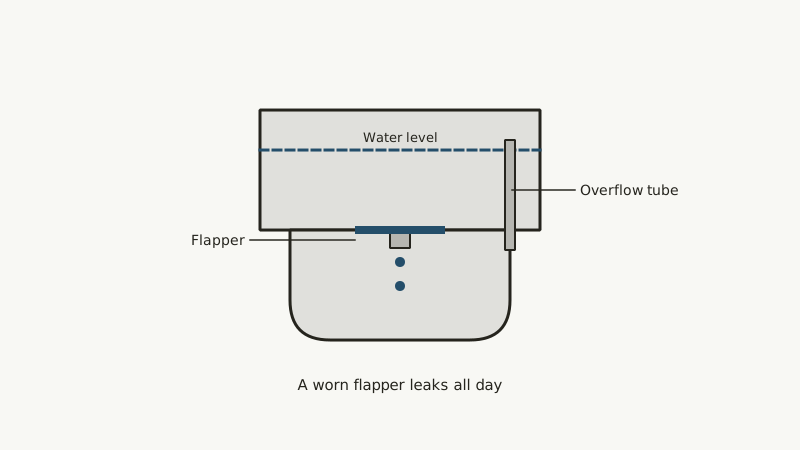
A dye check settles it. Drip a little food coloring into the tank and leave the flush alone for a quarter hour or so. If tinted water shows in the bowl, the seal has failed. The remedy is frequently a cheap part, and our page on a toilet that keeps running walks through it. Taps matter too. By the EPA's arithmetic, one drip every second adds up to over three thousand gallons a year, and the leaky faucet guide shows a quick repair.
What if the leak is somewhere I cannot see?
Hidden leaks live inside walls, beneath floors, in the yard line past the meter or under a slab. Typical clues: a meter dial that keeps inching forward with all taps closed, a patch of floor that stays warm, a musty cabinet, a soggy strip of lawn, or the faint sound of water in an otherwise quiet house. Long Beach Utilities adds that mold or a foul odor behind cabinets is a tell.
Whatever pipe lies between the meter and your wall is the owner's, which makes a yard leak your bill and your repair. Finding one without trenching is what leak detection exists for, and the numbers for a slab version sit on our slab leak cost page. One safety point: a gas smell near wet areas means walking outside and phoning from there. Long Beach and Signal Hill are served by Long Beach Energy Resources, (562) 570-2140; most surrounding cities (Lakewood and Seal Beach among them) are on SoCalGas, 1-800-427-2200.
For scale, the EPA reckons the average home loses over nine thousand gallons a year to leaks, with roughly one house in eleven losing fifty gallons or more every day. Catching yours early is cheaper.
Why do pipes leak to begin with?
Usually age, corrosion and too much pressure. Steel rusts or pits, joints loosen when a house settles, fittings wear out, and overpressure strains everything at once. In Long Beach, galvanized steel in bungalows around Belmont Shore and Bixby Knolls can rust from the inside out, and salt air speeds corrosion on exposed runs.
Other materials fail differently. Copper pinholes frequently come from walls thinned by years of contact with the water; plastic lines more often seep at a joint whose glue or clamp has aged. The longer explanation is in why pipes split, and an overlooked trigger, a regulator that has stopped doing its job, is covered under adjusting the regulator valve.
What noise does a bursting pipe make, and is banging the same thing?
A rupture sounds like a sharp crack or bang, then a continuous rush or spray that does not quit until the supply is cut. Banging that comes and goes with a tap closing is water hammer, a different animal. It annoys and wears fittings over time, yet it does not flood a room.
A steady roar or hiss with every tap shut calls for the main valve and a phone call. More clues appear in our note on spotting a ruptured line, and the gentler case is in water hammer sounds. Our request window runs weekdays from nine to five. Outside it, lean on the main shutoff and the city's water emergency number, (562) 570-2390.
Why does it jump in winter, and will the city forgive a leak?
Cold-season spikes usually have a nameable reason: taps left dripping against frost, holiday visitors, or a leak that stayed masked when irrigation was off. Also check whether the billing period simply spans more days than usual, so compare days as well as dollars.
Long Beach grants a partial adjustment, but only for hidden or underground leaks you could not reasonably have discovered. Faucet and toilet leaks are excluded. You must hold the account, finish all repairs first, act within 45 days of the bill date, attach proof, and show consumption at least double the prior year. One adjustment per account is allowed every three years, credits post to the account rather than paying you cash, and the utility does not cover detection or repair costs.
The residential leak-help number is (562) 570-5700 if you think you qualify.
When is it worth paying someone to come look?
When the meter keeps moving with everything off and you have ruled out toilets, taps and sprinklers. Someone with the right tools can pressure-test lines, listen for concealed water, inspect the heater and softener, then price a repair. Repiping or equipment replacement generally calls for a city permit.
A softener stuck in endless regeneration can be the cause too, and how a unit is set up is described on our softener installation page. Have the meter readings, the bill and your list of ruled-out suspects ready when you fill in the quote form. Our service areas around the harbor are listed on the areas we cover page.
Common questions
Is it possible for a leak to stay hidden?
Yes. Plenty sit inside walls, under slabs or in the yard line. A bill that rose though nobody changed habits, a dial spinning with all taps shut, or one warm patch of floor tell you more than a puddle does. Do the meter test first, then pick a theory.
Does the city credit a leak caused by a toilet?
No. Long Beach says high bills from faucet or toilet leaks do not qualify for an adjustment. The program exists for hidden or underground leaks that the customer could not have found. Not sure which category yours falls in? Submit the application and let the utility rule on it.
Might the water heater be the source?
Possibly. The utility lists a leaking heater among high-bill causes. Examine the base for dampness, rust or a puddle, and check the relief valve discharge pipe for drips. Tank leaks are not patchable, so the cure is replacing the unit.
What if the meter test is clean but the bill stays steep?
Then the water was used, not lost. Compare billing dates, guests, sprinkler runs, a pool or hot tub fill, and laundry loads. The portal's daily history can pinpoint the spike. If nothing explains it, ask the utility to verify the meter reading.
References
Updated