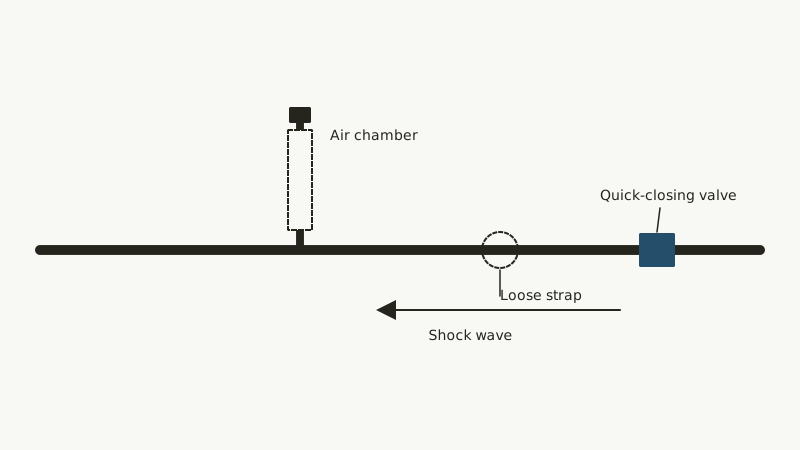
One slam of a pipe at 2 a.m. gets your attention. That bang is moving water slamming to a halt: a valve closes, the moving column of water meets a wall, and its momentum has to go somewhere, so the pipe takes the blow. Usually it is more irritation than hazard, and cheap to cure. Below: how to decode the noise, what to measure, and where it stops being a job for you. Our other trade jobs are listed on the Harbor Lights home page, and fixes for Long Beach homes follow below.
Is that bang, knock or shudder really water hammer?
Probably, if it happens the instant a tap, dishwasher, washing machine or toilet shuts off. Water hammer sounds like a single loud bang, repeated knocking, or a brief shudder that travels through the walls. Noise that starts when a faucet opens, or that whines steadily, is usually something else, such as a worn washer or a failing valve.
Timing is the clue. Note which fixture triggers it. If it is the washing machine or dishwasher, whose valves snap shut, the culprit is the fast-closing valve. If it is any tap, in any room, the whole house is carrying too much pressure or has lost its air cushion. A knock that follows the heater cycling, rather than a tap, is a separate story, handled further down.
What actually causes the pipes to bang?
Most homes trace to one of four: appliance valves that snap shut, supply pressure set too high, loose straps that let pipe swing, or air chambers and arrestors whose cushion has gone. Any of them alone can produce the sound, and in an older house two or three often combine.
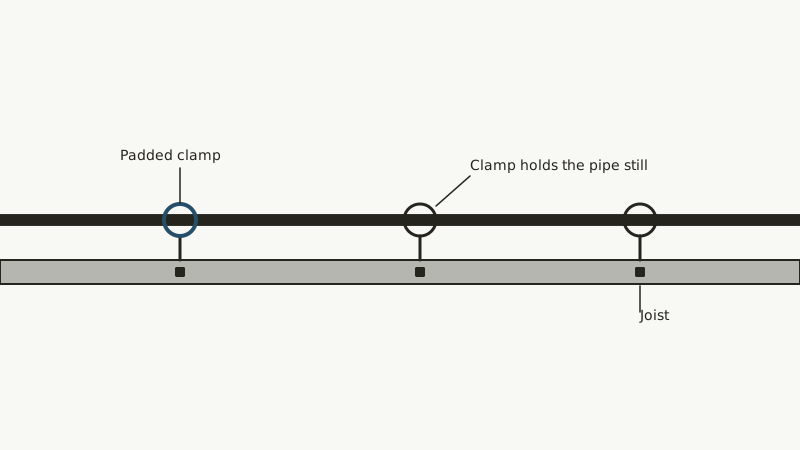
The physics is simple. Water cannot be compressed, so when flow stops in an instant the shock bounces back and forth along the pipe. A tank of air, or a spring-loaded arrestor, gives the shock somewhere to go. Pipe that is strapped firmly cannot jump against a stud. Our pressure regulator pages explain the device that keeps the whole system calmer.
Does excess pressure explain the banging?
It can, so measure it first. Thread a gauge onto an exterior spigot and note the resting pressure. State code makes a regulator mandatory above 80 psi, and A. O. Smith's maintenance guide notes that most experts set the regulator at 50 to 60 psi to protect appliances. Higher pressure means a harder slam.
A worn regulator can also creep upward over time without anyone noticing, so a home that was quiet for years can start banging. If the gauge shows more than 80, the answer is a regulator adjustment or replacement, which is what adjusting the regulator and replacing it cover. Cost context is on the regulator installation page.
How do I quiet it without calling anyone?
Start with the free items. Look for exposed pipe in the garage, basement or attic and see whether it moves when the noise hits, then add padded straps where it does. Next, recharge the air chambers: shut the main, drain the system by opening taps at both the highest and lowest points, then close those taps and let the main refill the lines slowly so air returns to the chambers.
Do that only if your house has the simple capped vertical stub of pipe behind a fixture; many do not. If the bang is from one appliance, a small arrestor screws onto the supply valve between the wall and the hose, and the plumbing code's water hammer section calls for approved arrestors where quick-acting valves are installed. Follow the maker's instructions for fitting it.
When does the hammer point to something I should not ignore?
When the noise comes with a leak, a stain, a sudden pressure change, or pipe that visibly jumps. Repeated shocks stress joints, and over years a hammering system can open a weak fitting. Thermal expansion can mimic it: a water heater on a closed system without an expansion tank raises pressure each cycle, and the maker warns that it damages the heater.
A dripping relief valve frequently signals pressure that runs too high. For that route, read how an expansion tank gets swapped. One warning for gas heaters: a rumble or hiss at the burner, or any gas smell, means getting out and phoning the gas utility, not a plumber.
What will a plumber do, and what might it cost?
A plumber measures pressure first, then checks the regulator, straps, arrestors and the heater's expansion tank, and writes down a price before starting. Fixes run from strapping or an arrestor up to a new regulator or expansion tank, mostly short visits where the regulator is the costliest part.
A new regulator is the usual bigger repair; guides list it at a few hundred dollars before access complications. A firm figure is not given here, because a regulator mounted in a garage is nothing like one buried behind stucco. To get one, describe the noise on the quote page, and expect the gauge reading to come first.
Common questions
Will water hammer damage my pipes?
It can, over time. A single bang is harmless, but years of repeated shocks wear fittings, loosen straps and stress appliance connections. Fixing it is cheap compared with replacing a leaking joint inside a wall, which makes persistent banging a repair worth booking instead of a quirk to endure.
Why do the pipes slam only after a laundry cycle starts?
A washer's fill valves shut in a split second, and that is a sharp jolt for the pipe. A small arrestor on the machine's supply valve usually cures it. If the bang is new, check whether the water pressure rose or a strap came loose, since the machine did not change but the system around it may have.
Does the problem get worse in older houses?
Often. Older Long Beach homes, such as 1920s to 1950s bungalows near the water, may have galvanized pipe with scale that restricts flow and old old air chambers waterlogged over time. Tract homes built later tend to have different issues. Either way, a pressure reading tells you more than the house's age does.
Should I phone the last contractor if the banging began after their visit?
Reasonable to try. Explain the timing, and read the invoice for any terms they stated about their work. Whatever they say, get any further repair priced in writing before it starts, so you can compare it with a second opinion if you want one.
References
Updated