Cold showers from an electric tank come from a handful of causes: no power reaching the heater, a safety switch that opened, or a part that can no longer make heat. Work the list from the electrical panel down to the tank. If nothing here brings the heat back, the broader water heater repair page covers your next move.
Why did my electric tank quit heating?
Four faults cause nearly all of it: the breaker tripped, the high-limit safety switch popped, a heating element burned out, or a thermostat failed. Your symptom points the way, because a stone-cold tank, one that runs out within minutes, and one that never gets past lukewarm each implicate a different part.
| Symptom | Where to look |
|---|---|
| Never gets warm at all | Breaker, safety switch, upper element, upper thermostat |
| Hot at first, then cold quickly | Lower element |
| Stays lukewarm | Lower element or its thermostat |
| Safety switch pops again and again | Shorted element or faulty thermostat |
| Water is hot, flow is just weak | Not the heater; look at the plumbing |
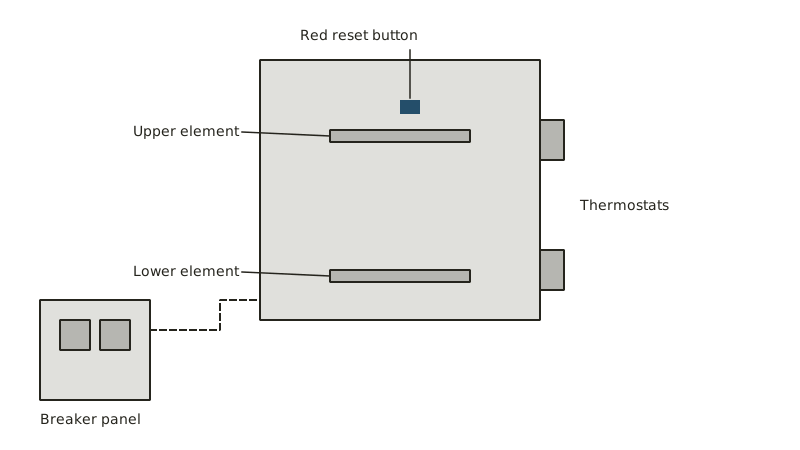
Two elements live inside the tank, high and low, and each takes orders from its own thermostat. The top thermostat acts as the gatekeeper. It feeds the upper element until that zone is hot, then hands the current down to the lower one. When the gatekeeper breaks, the lower half may never get power.
Where do I start, and how do I stay safe?
Walk to the electrical panel and find the heater's breaker: usually a 240-volt pair of linked switches. A handle stuck halfway has tripped. Slide it fully off, then on again. A breaker that drops out again immediately stays off; that signals a wiring or element fault that needs a professional.
Treat this circuit with respect. At 240 volts it can kill. Open the breaker before taking any cover off, and prove the wires are dead using a non-contact tester. Also never restore power until the tank is completely full, because an element energized in air can destroy itself within moments.
Scorched insulation, melted wire coating or any trace of water in the wiring compartment ends the do-it-yourself part. Call a plumber or electrician.
What does the red button do?
Behind the upper cover, under a strip of insulation, the top thermostat carries a red button. It is the high-limit (energy cut-out) switch, and it opens once the tank overheats. With the breaker off, push the button until it clicks, replace the cover, then restore power and allow about an hour to heat.
One click means you probably found the cause. If it pops again by the next day or so, quit pressing it. The switch is warning about an element that has shorted or a thermostat that will not shut off. Because the limit lives inside the upper thermostat, a bad one means swapping that entire thermostat.
Never hold the button down or defeat it. It stands between a hot tank and boiling water.
Which part is bad?
With power off, testing follows an order: the supply at the breaker, the limit switch, the top element and its thermostat, then the bottom pair. A healthy element commonly measures roughly 10 to 30 ohms on a multimeter, while an open circuit or a reading to the tank's metal skin condemns it.
Use a multimeter only if you already know how. A plumber runs the same sequence in a few minutes. Elements are the usual casualty, and mineral scale hastens the end, since the crust traps heat against the metal. Swapping one involves draining the tank below the element, backing out the old one, fitting a fresh gasket and element, and refilling completely before any power returns.
To see how a service call unfolds, read hiring a plumber for a heater leak; the flow is similar for repairs.
Fix it or replace the tank?
Replacing an element or thermostat on a sound tank is a small repair and nearly always worth doing. Age settles the question. Published figures give a tank heater about 10 to 15 years, and when a repair approaches half what a fresh unit costs, replacing usually wins.
Look at the data label for the build date. Rust-tinted water, wet spots at the base or a rumbling tank during heating all suggest an aging, scaled-up shell. Lifespan is covered in how long a tank typically lasts, and budgeting in replacement pricing.
On the permit side, Long Beach does not require one for repairing a heater you leave connected. Replacing the unit does require a permit, and every tank must be strapped to the wall.
Is the heater even the problem?
Not always. Another appliance on the same circuit may have tripped the breaker. A worn mixing cartridge in one faucet can fake a heater failure. If only a single tap runs cold while others are hot, the water heater is off the hook.
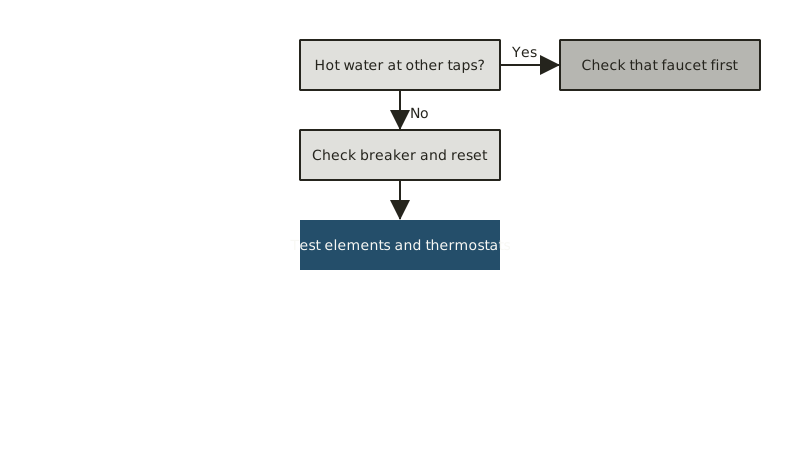
Try a hot tap near the heater and another far away. Hot nearby but cold far away puts the trouble in the pipes or a partly closed valve. When a lone sink lost its hot side, the checks are in a kitchen faucet with no hot water.
Common questions
Why won't my electric water heater heat?
Most often a breaker or reset switch has tripped, or an element or thermostat has died. Start at the panel, then press the red button with the power off. If heat does not return, an element is the likely culprit, and a plumber or electrician can test and swap it.
How do I press the reset properly?
Breaker off. Open the upper panel, press the red button until it clicks, close everything up, then switch the breaker on. Wait for the tank to warm. A button that pops a second time should not be pressed again, because something is shorted and needs repair.
How long do elements usually survive?
There is no fixed number. Several years is typical, and hard water cuts that short. Scale buildup and dry firing kill elements early. When one goes, the other is often near the end, which is why some plumbers replace the pair together.
Who do I phone, a plumber or an electrician?
For element, thermostat or reset problems on the heater itself, start with a plumber, since the tank and plumbing connections are part of the job. Scorched wiring, a repeatedly tripping breaker or a damaged panel belongs to an electrician. The plumber can usually say which one the problem needs.
This guide is one of many on plumber in Long Beach.
References
- City of Long Beach, plumbing permit and water heater requirements
- California Contractors State License Board, hiring a contractor
- Water heater manufacturer troubleshooting guides for electric tank models, checked November 2026
- Published water heater repair cost guides from several plumbing sites, checked November 2026
Updated