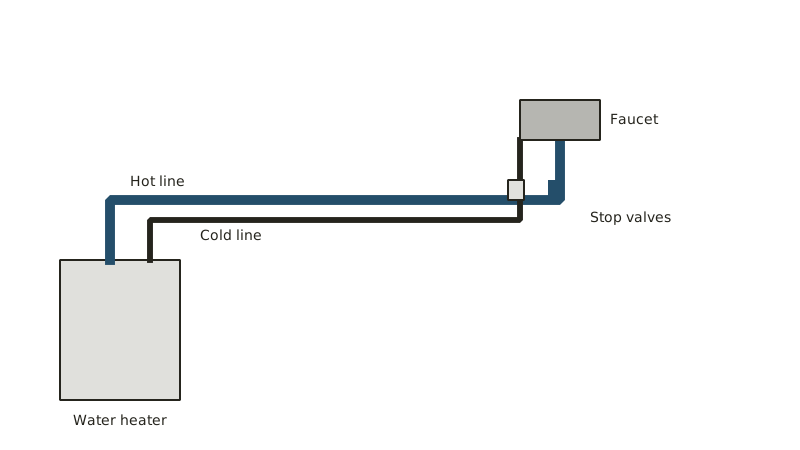
Why does the hot faucet give no water while the cold works?
When one fixture is dry, suspect its clogged aerator, failed cartridge or half-closed stop valve. When every hot tap is dry, the trouble sits upstream: a closed or failed valve at the water heater, a blocked hot line, or a heater that is off. Which taps fail tells you where to look. Other fixture problems are covered under faucet, sink and shower repair.
Open the hot side at a second faucet, a shower and the laundry sink. That two-minute walk halves the search. It also separates "no water" from "no hot water": a hot tap that runs cold points at the heater, while one that delivers nothing means a restriction or a shut valve somewhere. This page is about the second case.
What if only one faucet has no hot water?
Open with the little stop valve below the sink, then take the aerator off and look for grit, and only then blame the cartridge or supply hose. A partly closed valve, debris in the aerator or a worn single-handle cartridge account for most cases, and each is a few minutes of work.
Work in this order:
- Run the cold side. If it flows fine, the faucet body is not the problem.
- Find the hot supply line under the sink, normally on the left, and turn its handle fully open.
- Close the stop valves, twist off the aerator at the spout tip and rinse out grit or white scale.
- Pull the cartridge or the handle assembly if the faucet is a single-handle design. A cracked or seized cartridge can block the hot side while the cold side still works.
- Disconnect the hot supply hose into a bucket, briefly, with the valve cracked open. If water pours out, the faucet is the fault. If it dribbles, the valve or the line behind it is.
Older faucets in 1920s to 1950s bungalows, with original corroded stop valves, may not close or open cleanly, and replacing the valve costs less than fighting it. If the cartridge is worn, repairing a leaky sink faucet shows how to swap it.
What if the hot water is missing everywhere in the house?
Confirm the heater is switched on, its cold supply valve is open and the pilot or power is alive. A blown-out pilot is the usual gas culprit, a tripped breaker the usual electric one, and a closed or failed shutoff can leave the hot side empty as well.
Everything-hot-is-dead has a short suspect list:
- The cold feed valve at the heater was closed, so nothing can flow out the hot side.
- The gas heater's pilot is out or the unit shut down on a safety. Gas control dials usually have pilot, on and off positions, and the label on the tank explains relighting.
- The electric heater lost power or a tripped element breaker.
- A shutoff or check valve in the hot line failed.
- A kink, a plugged filter or a crushed flexible connector at the heater.
- Heavy sediment in an old tank.
The moment you smell gas, troubleshooting stops. Do not light anything; get out and call 911 plus the gas utility. Long Beach Energy Resources supplies Long Beach and Signal Hill, emergency line (562) 570-2140, while neighboring cities buy from SoCalGas, 1-800-427-2200.
A fuller checklist is in reasons for no hot water, and a flame that burns while the water stays cold has a page to itself, pilot on but no hot water.
Could the shower or a mixing valve be the problem?
Yes. A shower with a pressure-balancing or thermostatic mixing valve can lock out the hot side when a cartridge fails or debris lodges inside. The tell is hot water at the sink and none in the shower. Replacing a valve cartridge is a job of an hour or two, and replacing the valve body means opening the wall.
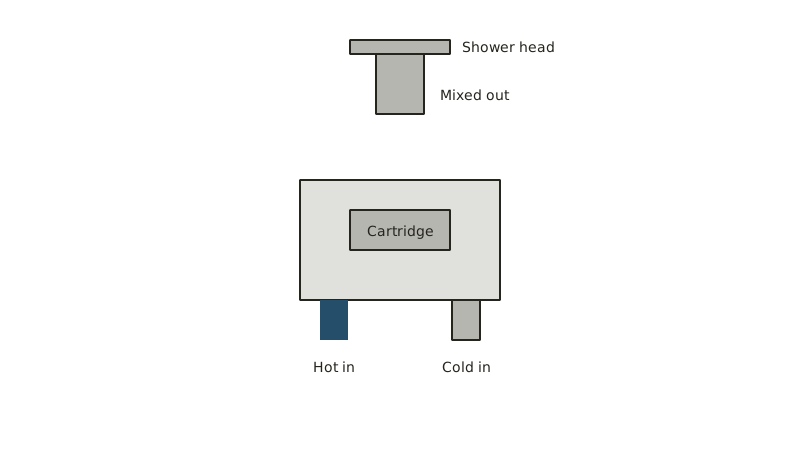
Anti-scald valves exist to hold a safe maximum temperature, and some will cut the hot side if the cold supply drops suddenly. If the shower stopped delivering hot water after other water was used in the house, that is normal behavior for a balancing valve, not necessarily a fault. For other shower trouble, see low shower water pressure and fixing a shower leak.
Could the heater or a valve have failed?
Yes. Old tank heaters collect sediment that can restrict the outlet, valves seize with age, and a heater at the tail end of its service can stop passing water. Long Beach's coastal air also corrodes exposed fittings and flex connectors. A plumber can test flow at the heater outlet, and repair or replace what failed.
A heater a decade old, with a rusty tank, leaks or crusty fittings, may be better replaced. Options appear in water heater repair, and prices for a swap on gas heater replacement costs. Do not drain or remove a heater yourself without shutting off gas or power first, and remember that the relief valve on a heater is a safety device, not something to cap or plug.
Water heater replacement is regulated work in California, with permit and strapping rules, so keep any repair within what you are comfortable doing and let a contractor handle gas and venting.
Could the hot line itself be blocked or broken?
A hot line that has split, corroded closed or been crushed can starve the fixtures it feeds. Clues: no flow from some hot taps, a damp wall or ceiling, a hiss near the pipe, or a slab floor that feels warm underfoot. A galvanized hot line in an older house can scale shut from the inside.
Galvanized steel supply pipe was common in houses built before the 1960s and often clogs with mineral buildup long before it leaks. Strong cold flow beside a hot trickle at several fixtures points that way. Pressure readings at the heater and a trace of the hot line show whether a repipe makes sense. More on that in galvanized pipe replacement and burst pipe clues.
How do you book help, and what should you tell the plumber?
Say which taps lack hot water, whether cold works, the heater's type and age and your own attempts, then use the quote form. We read requests weekdays between 9am and 5pm, arrange a plumber to visit, with the price written out before work.
Beyond a simple valve or aerator fix, request the contractor license number, since California requires one on jobs of $1,000 or more, labor and materials combined. The Harbor Lights home page outlines how a visit is arranged.
Common questions
Why does cold flow while hot gives nothing?
The two sides are separate pipes. Cold comes straight from the supply, and hot must pass through the water heater first. A shut valve at the heater, a pilot or power failure, a blocked line or a faulty cartridge can leave hot dry while cold flows. Test several taps to see which.
What if just one tap has no hot water?
Usually the faucet itself: a clogged aerator, a shut stop valve, a worn cartridge or a kinked supply hose. Hot water elsewhere proves the heater and main line work. Check the stop valve and aerator first, then the cartridge, and book a plumber if the supply line is at fault.
Is it risky when a heater stops delivering?
Mostly it is an inconvenience, but a gas unit whose flame keeps dying, a gas smell, scorch marks or water around the base is a safety matter. Leave the building for a gas smell and call from outside. Keep the thermostat at the maker's suggested setting once repaired, to avoid scalds.
Can sediment stop hot water from flowing?
It can. Sediment can restrict the heater outlet and reduce flow, and hard water speeds buildup. Flushing a tank is a maintenance task some owners do, but an old, crusty tank may not survive it. A plumber can judge whether to flush, repair or replace.
Should I turn the heater off if there is no water?
If the tank is full and the cold side works, there is little risk in turning an electric heater's breaker off, but do not run an electric heater dry. For gas, set the control to pilot or off. If you are unsure whether water is reaching the tank, turn power or gas off until it is checked.
References
Updated