A plumber's hourly number sounds like a wage until you see where it comes from. Behind each dollar sit the truck, the insurance, the license, the office phone and the parts run, which is why the rate is bigger than the paycheck. Below, a plain reading of the numbers published for this region, followed by the add-ons that surprise people. Our home page lists the work we arrange around Long Beach, and the notes here help you judge any quote you receive.
What hourly figure is realistic in and around Long Beach?
Guides published for 2026 mostly cluster plumbing labor in a $75-$150 hourly band, stretching from near $45 up to $200. California lands in the costly tier, about $100-$200, and master plumbers show the same $100-$200. Local bids more likely sit above the national middle than below it.
Gas work tends to be priced a little higher. Los Angeles guides show about $80 to $225 an hour for gas specialists. Those are published ranges, not a promise: the final charge depends on the firm, the task and what time you ring, and only a written estimate is binding.
Why is the shop rate so much higher than what a plumber earns?
Because the rate pays for more than hands on a wrench. As a reference point, California's wage determination for plumbers on public works in Los Angeles County lists a basic hourly rate of $64.83, and $94.22 once health, pension and training payments are counted. That covers labor alone, before a van, tools, insurance or a bond.
A shop rate has to absorb those costs and the unpaid time around a job: driving, ordering parts, writing the estimate. So a quote far under the going rate can mean corners are cut somewhere, such as insurance or a permit, though it may also just be a small shop. A reasonable rate and a clean paper trail are better value than a bargain with neither.
What else lands on the bill besides the hourly rate?
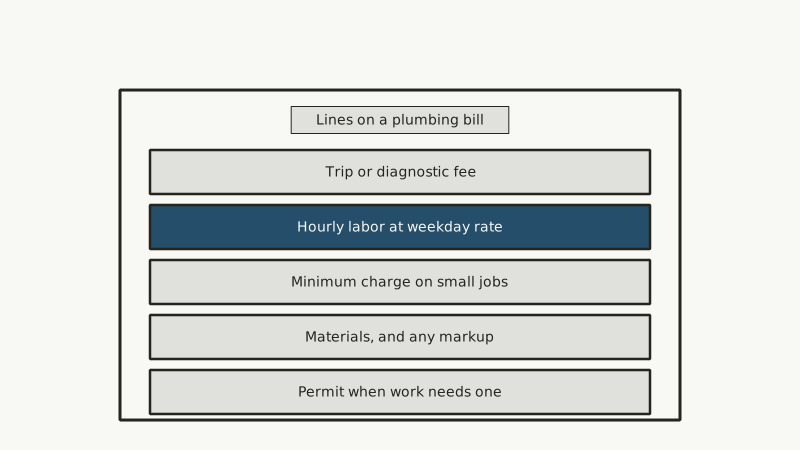
Five things: a trip or diagnostic fee, a minimum charge, after-hours premiums, materials, and a permit when the work calls for one. Guides put trip fees at about $50 to $250, minimums at $200 to $250 on small repairs, and night or weekend work at 1.5 times to 3 times the weekday rate.
On emergencies, one national guide gives an average near $170 an hour with most households paying $100 to $500, and more on holidays. Materials are billed separately, so ask whether parts carry a markup. A Long Beach plumbing permit is needed when fixtures or piping are replaced, though a leak stopped with no new materials is exempt. Ready to see how that works on your job? The quote form starts it.
Can I estimate a job myself with a repair cost estimator?
Roughly, yes. Multiply the likely hours by the hourly rate, add the minimum or trip charge, add the parts, and include the permit if needed. A one-hour fix at $100 to $150 plus a $75 to $150 trip fee comes to about $175 to $300 before parts. Estimators online do the same sum, so use them for sanity, not as a final answer.
| Job shape | How the bill is built |
|---|---|
| Quick fix, under an hour | Trip fee, a one-hour minimum, small parts |
| Half-day repair | 3 to 4 hours at the hourly rate, parts, maybe a permit |
| Night or weekend emergency | Call-out fee plus 1.5x to 3x hourly, parts |
| Whole-house piping | Usually quoted as one price, not by the hour |
How are specific jobs like a spigot, a valve or a busted pipe priced?
By time and parts. Replacing an outdoor spigot is quick when it threads on and takes longer when it is soldered inside a wall. A shutoff valve is a short job if it can be isolated, and longer if the main must be turned off first. A burst pipe is priced on access, damage, and whether it is a quick patch or a section replaced.
Because the work varies, no honest page can fix a single dollar amount to these jobs. Have the plumber put hours and parts in an estimate you can read. Ranges for entire jobs are in the plumber cost guide, and trip charges are broken out under service call fees.
Does plumbing get priced per square foot?
Only for big jobs. Repipe guides quote around $2-$7 a square foot with PEX and $4-$14 with copper, and new construction bids may do the same. For repairs the idea does not apply, because a leak under a sink costs the same in a studio as in a mansion. Treat per-square-foot figures as rough guides for the large projects only.
That style of pricing appears in our repipe price table. For a new house, see plumbing cost for a new house. For anything routine, expect hourly or flat-rate quoting instead.
How do I tell whether a quote is fair?
Compare it with the ranges above, then ask for specifics. A fair estimate names the work, separates labor from parts, states the trip fee and any minimum, and says whether a permit is included. Gather a pair of bids built on one scope. Jobs above $500 in California need a written contract.
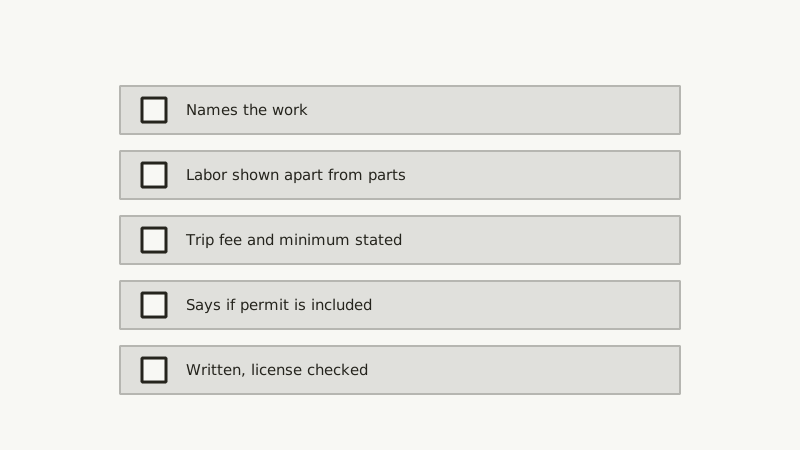
Search the license on the board's website; its plumbing classification takes in gas piping and water heaters, so the plumber can show you one. An advance cannot exceed the smaller of 10% and $1,000. Distrust a quote that will not be put in writing, or a figure that moves once the work begins.
Common questions
Which is the better deal, hourly billing or one flat price?
Neither wins every time. Hourly suits short, obvious work. Flat pricing suits murky jobs, since the contractor absorbs the surprise. Request the flat price on paper after the plumber has inspected it, plus a list of what could change it.
Is driving time billed?
Often, in the form of a trip fee, or the meter starts at arrival, or the drive is folded into a minimum. Guides list trip fees near $50 to $250. Find out whether the amount is deducted when you approve the repair, because policies differ from shop to shop.
Should I worry about a very low hourly rate?
Check it out before you accept. Low rates sometimes mean no insurance, no license or an expectation of extra charges later. Confirm the license number, learn what that price includes, then compare it with another bid. A rate far below the published range is a reason to ask more questions, not a reason to say yes.
References
- California Department of Industrial Relations, general prevailing wage determination for Los Angeles County, LOS-2026-2
- CSLB, C-36 Plumbing Contractor classification
- California Contractors State License Board, home improvement contracts
- City of Long Beach, plumbing permit requirements
- Published plumber hourly rate, service call and emergency rate guides, checked November 2026
Updated